Magento Integration with ERP
Magento ERP integration is essential for businesses seeking to automate operations, improve efficiency, and deliver a superior customer experience. By connecting your Magento store with an ERP system, you gain real-time visibility, reduce costs, and position your business for scalable growth in a competitive eCommerce landscape.
The following article will help you identify the role of eCommerce and ERP within your organisation and highlight the key areas where Magento integration with ERP provides a competitive advantage. It will also guide you in mapping your eCommerce process flow and demonstrate how automation can significantly improve the efficiency and accuracy of eCommerce data management.
Codeless Platforms, a market leader with over 25 years of experience in business process automation and ERP integration, has successfully completed more than 7,500 implementations for clients across industries. Our iPaaS solution, BPA Platform is widely recognised for its flexibility, no-code/low-code approach, and seamless integration with major ERP systems such as SAP, Microsoft Dynamics, Sage, NetSuite, Acumatica, SYSPRO, and Epicor. By leveraging Codeless Platforms’ proven solutions, organisations can eradicate repetitive data entry, reduce operational costs, and achieve faster order-to-dispatch times, as demonstrated by real-world Magento ERP integration case studies such as Nottingham Forest Football Club, which streamlined its retail operations and reduced staffing needs by two-thirds through automation.
An additional eCommerce process flow workbook is available for you to use as a starting point to model your own processes and outline an automated eCommerce process. This resource can be downloaded below.
What is Magento ERP Integration and why is it important?
What is Magento ERP integration?
For many organisations, Magento–ERP integration is just one milestone within a wider roadmap for digital transformation, ensuring eCommerce, ERP, finance and fulfilment systems can scale together without creating long-term technical debt.
Magento ERP integration links your Magento online store with an Enterprise Resource Planning (ERP) system, allowing for seamless automation of business processes and efficient data flow between platforms. This connection ensures that essential information, such as inventory, customer records, and order details is automatically synchronised, reducing manual administration and reducing the risk of errors.
Why is Magento ERP integration important?
Integrating Magento with an ERP system is crucial for modern eCommerce businesses aiming to scale and compete effectively. Here’s why:
1. Streamlined Operations and Automation
Automates repetitive tasks like order processing, inventory updates, and customer data management, freeing up staff to focus on growth and customer service.
Reduces manual data entry, which lowers the risk of human error and speeds up business workflows.
2. Real-Time Data Synchronisation
Ensures that inventory levels, sales, and customer information are always up-to-date across all systems, preventing stockouts, overselling, and data discrepancies.
Real-time updates enable accurate demand forecasting and better decision-making.
3. Enhanced Customer Experience
Provides customers with accurate product availability and order status, leading to higher satisfaction and loyalty.
Enables faster order fulfillment and personalised service by centralising customer data.
4. Cost Optimisation and Efficiency
Reduces operational costs by eliminating redundant systems and manual processes.
Automates financial reporting, invoicing, and shipping, which improves resource allocation and profitability.
5. Scalability and Flexibility
Supports business growth by handling increased order volumes, multiple sales channels, and expanding product lines without sacrificing performance.
Adapts to changing business needs with customisable workflows and integration options.
6. Data-Driven Decision Making
Consolidates data from various sources, providing advanced analytics and reporting to inform strategic decisions.
Helps identify trends, optimize pricing, and improve customer retention through actionable insights.
Buying behavioural patterns have shifted and expectations are higher than ever. This means that companies selling online are processing more orders, uploading new and existing product lines, and fulfilling more packages in the warehouse, ready for shipping, with limited resource.
In a recent eCommerce survey, tech company SearchNode found that company strategy has shifted with 45% of organisations now focusing on key areas of digital transformation and investing in new eCommerce software. Whether you are specialising in a B2B or B2C environment, digital transformation through integrating your Magento eCommerce platform with your ERP system will provide you with the tools you need to meet these demands. eCommerce integration will help you to process more orders and increase company output, quickly, efficiently and without error.
What is Magento eCommerce?
Magento (an Adobe company) is a market leading eCommerce platform which provides eCommerce merchants with a solution to sell their products online. Magento is built on a PHP framework, whilst predominately using MySQL for database management. A Magento platform can be deployed as either on-premises or as a platform as a service (PaaS).
Magento users can customise the look and feel and user experience of their online shopping presence whilst increasing sales opportunities by reaching a wider audience. By using an eCommerce platform, such as Magento, existing and new customers can access your products and services 24/7, 365 days a year.
Magento provides the opportunity for organisations of all sizes with the opportunity to sell online. Small businesses with only a few products or organisations with thousands of products can easily scale business operations with custom functionality. It’s not only the aesthetic customisation of the store itself that can be adapted but the ability to integrate a Magento platform with other business systems, such as ERP, CRM, email marketing and shipping systems, that can help improve operational efficiency.
Quick Magento Overview
- Built upon a PHP framework
- MySQL for database management
- On-premises or PaaS options available
- Customise the look and feel of your eCommerce store
- Ability to integrate ERP into a Magento platform
What is Magento B2B eCommerce Platform?
In addition to Magento being widely available for B2C organisations, the Magento B2B eCommerce platform is available to businesses specialising in a B2B environment, such as manufacturers, wholesalers and distributors. Magento Commerce for B2B provides the functionality a B2B organisation thrives upon, such as streamlining RFQs, improving customer quoting and price negotiations, purchasing limits, credit limits and thresholds and order approval workflow.
Magento B2B Features
Magento B2B eCommerce increases the functionality of Magento commerce for retail by including the following B2B features:
- Request for Proposal (RFQ)
- Order, quote and invoice tracking
- Credit limits
- Purchasing limits and thresholds
- Customer specific payment options
- Automated order approvals
- Self-service tools
Is Magento an ERP?
Although Magento is a solid eCommerce platform that can hold stock, pricing, customer information and can manage a range of business processes, Magento is not an ERP system and cannot fulfil all the requirements that a business needs. An ERP system combines the key modules, operations and any missing functionality of your Magento store to provide an integrated eCommerce solution. You may need to look at investing in an ERP system if you are seeing any of the following pain points:
- Increase in order volumes and manual data entry
- Increased delays in order processing and fulfilment
- Dealing with multiple suppliers and B2B relationships
- Data entry errors, e.g. wrong shipping address, product errors and wrong category listings
- Reduced employee productivity due to repetitive data entry
- High volume of products and inventory
What is the role of ERP in eCommerce?
In the eCommerce sector, an ERP (Enterprise Resource Planning) system is essential for optimising business processes and integrating multiple operational functions. It serves as a centralised platform to manage inventory, orders, customer information, financials, and more, allowing businesses to run smoothly and adapt swiftly to changing market conditions. By bringing these functions together, ERP systems enable companies to enhance inventory control, streamline order processing, strengthen customer relationship management, and boost overall operational efficiency.
Key modules most likely to be found within most ERP systems include accounting, order management, inventory, procurement, project management and, in some instances, CRM (customer relationship management). These modules and functions are integrated into one system to streamline and improve the management and visibility of information in day-to-day business processes to ensure data consistency across the business. In turn, this reduces operational costs by improving productivity, aids decision making and drives company revenue.
The role of ERP in eCommerce is an important one. There are a significant number of eCommerce costs that can slowly eat away at the profitability of increasing sales numbers. These hidden costs of eCommerce can predominantly be found within order processing and inventory management. The complete order management process is a vital, yet often costly activity. At the top level of your order management process, an order is placed within your Magento platform, manually processed and entered into your ERP software, and then passed to the warehouse for picking and fulfilment.
This is where ERP in eCommerce plays a key role, with the following areas being frequently called upon to work efficiently, without error:
- Customer: new, existing and guest accounts
- Item and stock: description, images, pricing, product details etc.
- Order: customer details, order value, products etc.
- Pricing: price changes and updates
- Accounting: process payments, place customer on credit hold, bank reconciliation, purchase orders etc.
- Shipment: shipping addresses, allocating products in the warehouse for fulfilment, pick lists, parcel tracking etc.
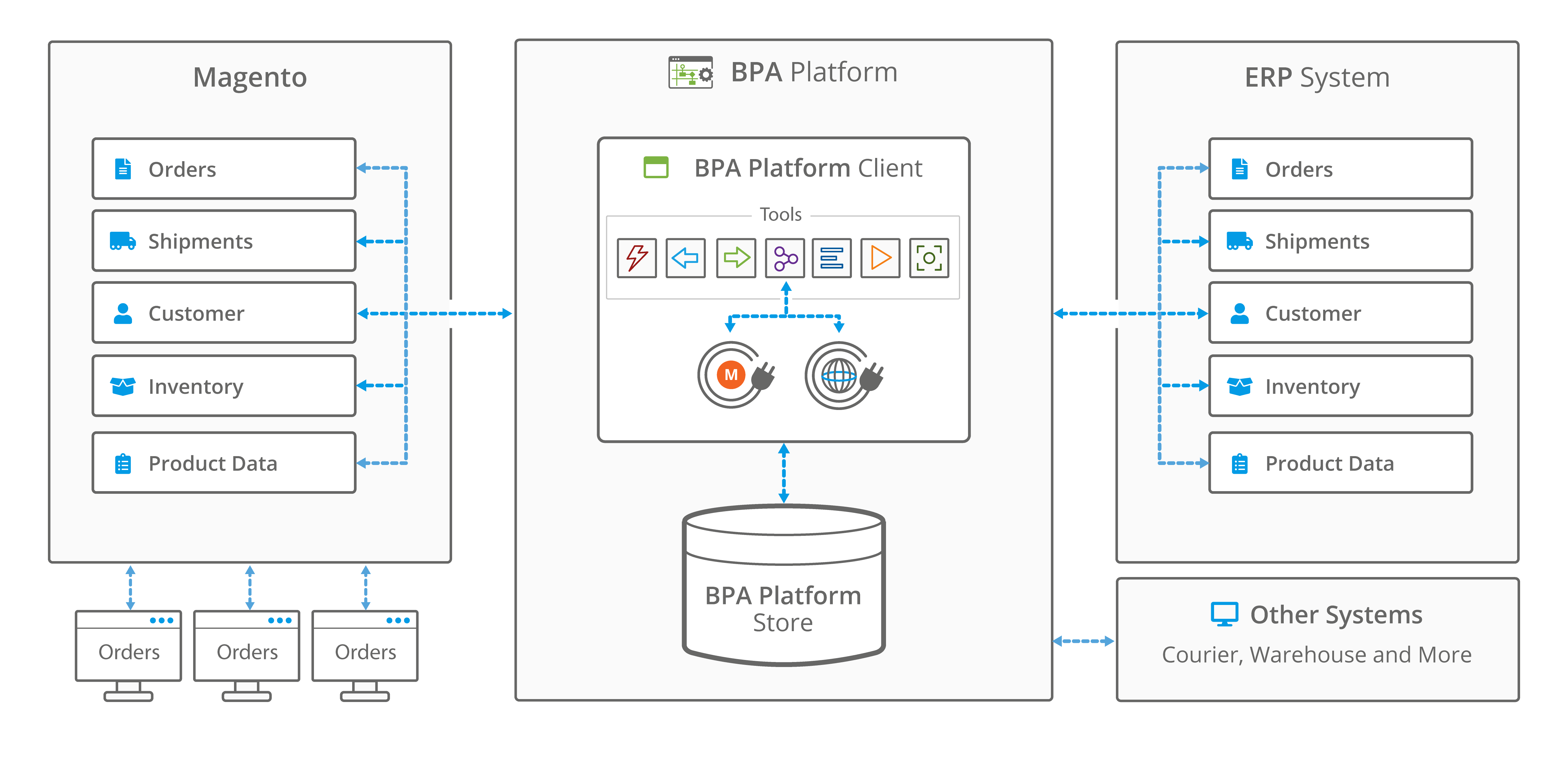
Example: Common Magento ERP integration process flow using BPA Platform
The ERP and eCommerce touchpoints mentioned above provide a low-level indication of the role of ERP systems in eCommerce. Many of these processes involve multiple departments and employees who need to manually update bi-directional data flows and monitor multiple systems for data changes, e.g. stock re-order points. This increases the risk of data entry errors, miscommunication, orders placed without sufficient stock levels, products placed in the wrong category and a decrease in customer satisfaction.
For many organisations, maintaining a manual eCommerce process with an increased volume of sales, higher demand in product lines, changing stock levels and processing payments is not a sustainable long-term business model. With the role of ERP systems in eCommerce becoming a vital element to business success, eCommerce professionals are turning to eCommerce ERP integration solutions to remove the hidden costs that quietly eat away at company revenue.
Mapping eCommerce Processes
Now that the role of ERP in eCommerce has been identified, start planning your eCommerce process flow to identify manual data processing tasks and highlight the key areas where an automated eCommerce process can be implemented. This will help you when discussing your integration project with your chosen Magento integration service.
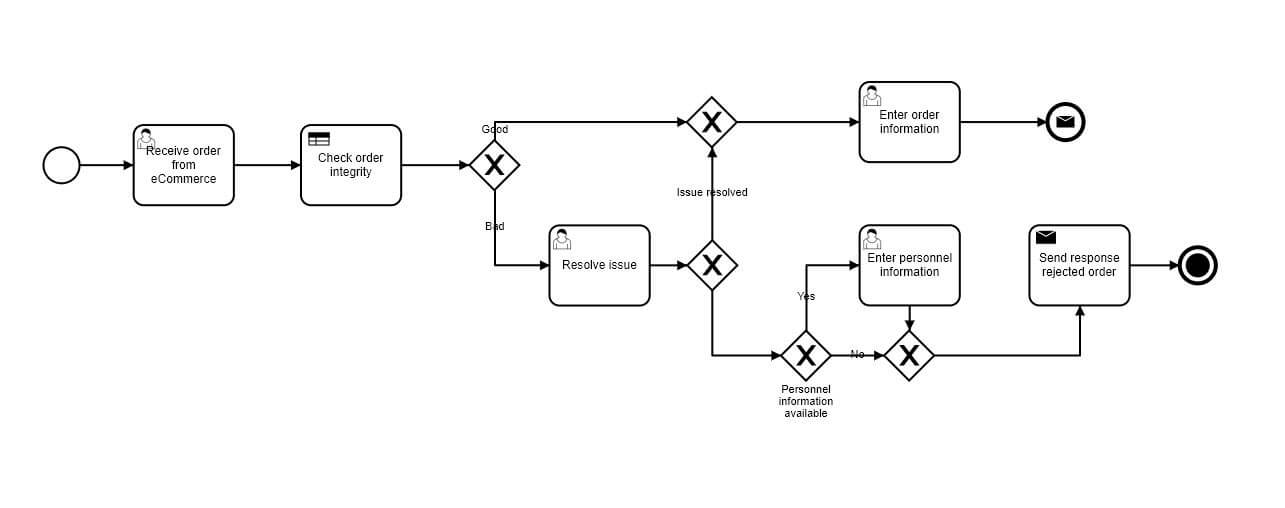
Image: eCommerce process example – receiving an order from an eCommerce platform.
Mapping your order management process can help you to identify where your hidden costs start and end. It will also help you to identify gaps within the eCommerce process and potentially highlight other areas within the business or process that can be automated to save the business time and money. Download the Mapping eCommerce Processes resource below and use it as a starting point to map your standard eCommerce process.
How do you choose the best ERP system for Magento?
Since we have discussed the importance of ERP in eCommerce and the role that it plays, you may be thinking what is the best ERP for Magento? Or if you already have an ERP system in place, you might be looking to move ERP vendors, or just simply be keeping an eye on the options available.
Selecting the ideal ERP system for Magento integration requires a careful assessment of your business requirements, the ERPs features, and the integration process itself. Start by identifying your operational needs such as inventory management, order processing, and customer data synchronisation, and ensure the ERP software can address these priorities effectively.
Key factors to consider
- Real-Time Data Synchronisation: Opt for ERPs that enable seamless, real-time updates between Magento and the ERP, ensuring inventory, orders, and customer information remain accurate across all platforms.
- Scalability: Choose a solution that can grow with your business, handling increased transaction volumes, expanding product catalogs, and supporting multiple sales channels without major reconfiguration.
- Customisation: Evaluate the ERPs ability to adapt to your unique workflows and business processes, including support for custom modules and integrations.
- Vendor Support: Prioritise vendors that offer comprehensive support, training, and ongoing maintenance to ensure a smooth integration and long-term reliability.
- Compatibility with Magento: Confirm that the ERP system is fully compatible with Magento, including support for necessary APIs, extensions, and data mapping requirements.
Steps for making the right choice
- Research and Compare Vendors: Investigate leading ERP providers, review their integration capabilities with Magento, and compare features, pricing, and user feedback.
- Assess Integration Methods: Determine whether the ERP offers native Magento integration, uses middleware, or requires custom API development, and choose the approach that best fits your technical resources and business needs.
- Request Demonstrations: Ask vendors for product demos or trial access to evaluate usability, interface, and real-world integration performance.
- Plan for Implementation: Develop a clear integration roadmap, including data mapping, timeline, and resource allocation, to ensure a successful deployment.
ERP software is an important part of the eCommerce function and is a key mechanism for reducing costs and improving the consistency in the services you provide your customers. There is no right or wrong ERP system for Magento. The ERP system that you choose will be dependent on several factors, such as business size, ERP cost, functionality required, industry specialism, whether you’re B2B or B2C facing or the modules needed, like manufacturing, procurement, and HR etc.
When choosing the right ERP system for your business, consider the following aspects:
- Are you a start-up business, SME or enterprise organisation?: The size of your online store and business model will help to make a short list of relevant ERP solutions.
- Do you need B2C or B2B eCommerce functionality?: Identifying the services you offer will highlight the functionality you need.
- Data and migration: Are you using an ERP system already? Where is your existing data held and can it be easily migrated into your new system?
- System integration Can the ERP system easily integrate with Magento and other business systems and applications?
- Cloud or On-Premises?: Think about your existing IT infrastructure, does the ERP system need to be on-premises or in the cloud?
Summary Table: ERP Selection Criteria Checklist
| Criteria | Why It Matters |
|---|---|
| Real-Time Sync | Prevents data discrepancies and improves efficiency |
| Scalability | Supports business growth and peak sales periods |
| Customisation | Adapts to unique business processes |
| Vendor Support | Ensures smooth integration and ongoing reliability |
| Magento Compatibility | Guarantees seamless data flow and system stability |
By thoroughly evaluating these factors and comparing ERP solutions, you can select a system that not only integrates smoothly with Magento but also supports your business’s long-term growth and operational goals.
Which ERPs are most commonly integrated with Magento?
A variety of ERP systems are frequently connected with Magento to optimise business processes and support growth. Popular options include SAP Business One, Microsoft Dynamics 365, NetSuite, Sage Intacct, Acumatica and Oracle ERP Cloud, each offering robust tools for automating workflows, managing inventory, and improving customer experiences when paired with Magento.
These ERP solutions provide features such as real-time data synchronisation, advanced reporting, and seamless order management, helping businesses streamline operations and deliver improved services to their customers. Integrating Magento with these leading ERP platforms enables companies to efficiently handle complex eCommerce requirements and scale their operations with confidence.
Regardless of which ERP system you use or invest in, leading Integration Platform as a Service solutions integrate seamlessly with most ERP systems. Codeless Platforms works closely with ERP vendors, such as SAP, Microsoft, Sage, SYSPRO, Access and Epicor, and their business partners to ensure that its ERP integration tools are always compliant and up to date with the latest technological changes. Some of the most common ERP systems that Codeless Platforms are asked to integrate with Magento include:
- SAP Business One
- SAP Business ByDesign
- Sage 200
- Sage Intacct
- Sage X3
- Sage 300
- Microsoft Dynamics NAV
- Acumatica
- Microsoft Dynamics 365 Business Central
- SYSPRO
- Epicor
- Exact
- Access Dimensions
- NetSuite
*If your ERP system is not listed or you are looking for an ERP provider, please contact us.
In summary, the focus of your ERP system is to enhance the service you provide to your customers. It helps day to day operations to run more efficiently and can help you to reduce costs and improve the consistency in the services you provide. Your customers like to be updated on the progress of their order, when it has left the factory or warehouse, its delivery status and delivery date. Synchronising the data held in multiple databases enables you to provide a consistent and positive customer experience.
What are the main methods for integrating Magento with ERP
Integrating Magento with an ERP system can be accomplished through several primary methods: custom integrations, prebuilt connectors, and iPaaS (Integration Platform as a Service) solutions. All of these approaches utilise API-based communication to synchronise data between Magento and the ERP system, ensuring seamless data flow and operational efficiency.
Magento ERP integration enables your business systems to ‘talk to each other’, pushing and pulling data, without employee intervention. An integrated eCommerce and ERP foundation ensures that your business processes become more manageable and streamlined, reducing the risk of human error and delays in order processing. The type of Magento ERP integration solution you choose will depend on the number of orders and products you are manually processing between your Magento store and your ERP system.
When looking for suitable Magento integration service it’s worth looking at the bigger picture of business process automation. In many instances, system integration is not just achieving A to B connectivity, and it’s not just a ‘plugin’. It’s the full process of streamlining your day-to-day manual processes to run more efficiently and cost effectively, the bigger picture of future business goals, and the processes that sit within the extended order management process.
Think about the start of the eCommerce process of uploading and coordinating stock and what happens after an order is synchronised. Payments need to be processed and reconciled; stock levels need to be updated; new product lines categorised and added to business systems with descriptions; orders need to be picked and packed and processed for fulfilment; reports need to be collated and sent to relevant employees; and so on.
“Maintaining a manual eCommerce process with an increased volume of sales, higher demand in product lines, changing stock levels and processing payments is not a sustainable long-term business model.”
There may also be instances where you would like to integrate a supplier portal or improve communication and the purchasing process with them. All these points need to be considered and planned for when planning your eCommerce ERP integration project.
Depending on business size and requirements, businesses processing a smaller number of orders will most likely research the market for ‘point to point’ Magento connectors or a Magento integration plugin to synchronise sales orders. Organisations processing hundreds or thousands of orders a day, and those with complex business processes, will research the market for a more robust, flexible and customisable Magento integration solution that can automate additional processes, provide data transform capability and act off database triggers. These solutions like Middleware and iPaaS can help a business to quickly adapt to changing business requirements as well as a variety of integration touchpoints and systems when required.
Here’s a more detailed breakdown of the main Magento ERP integration methods.
Point-to-Point Magento Integration
Point-to-point integration is a direct connection between Magento and your ERP system, typically developed in-house or by a third party. This method connects the two systems directly, without using middleware or a centralised integration platform.
Point-to-point Magento integration pushes order or product data from systems A to B. It can be a cost-effective way for a business to start its Magento ERP integration journey as point-to-point Magento connectors are built for a specific purpose in mind. Magento integration plugins can be deployed in minutes with minimal configuration. If a business is then looking to automate its order to fulfilment process and integrate its courier service, then that business needs to buy another connector suitable for that specific requirement to include system C, the courier provider, and so on.
Over time, as new point-to-point integration connectors are added, complications can occur. There could be 10 or 20 connectors from multiple software vendors, that all need to be managed and updated, reintegrated or repurchased when an ERP or eCommerce platform is changed. Multiple point-to-point integrations can place an unnecessary strain on IT infrastructure for the larger organisation and increases the risk of security issues and incompatibility further down the line.
Point-to-point integration is perfect for the start-up eCommerce business due to its low overheads, and the volume of orders being processed. If you are currently processing a high volume of orders and/or products, have complex business processes, experiencing issues due to point-to-point integration, or are planning to grow or even looking to change your business systems, then a flexible Magento integration platform is more likely to appeal to you.
Key features of point-to-point integration:
- Direct communication between Magento and ERP
- Simple architecture for straightforward data exchange
- No additional middleware required
Considerations:
- Less scalable as the number of connected systems grows
- More difficult to maintain if multiple systems are involved
- Best for small businesses or simple integrations with only a few systems
Custom in-house Magento integration
Custom integrations involve developing a tailored connection between Magento and your ERP system using APIs (such as REST or SOAP). This method provides maximum flexibility, allowing you to address unique business requirements, custom workflows, and specific data mapping needs.
Depending on resources in the IT department, it’s possible for some organisations to develop eCommerce integrations through bespoke development. However, this approach can cause some issues further down the line. For example, any modifications needed to the integration will often require the same software development team to make the necessary changes.
Additionally, can the initial integration keep up to speed with the demands of changing business requirements and APIs without a process failing?
Despite some organisations venturing down the route of bespoke eCommerce integration, it can be costly, extremely complex and time-consuming, as well as potentially lack the ability to keep up to speed with the modern business environment. It may also not be able to perform all of the functionality that you would like it to e.g. the extended order management process.
Bespoke eCommerce integration has gradually been replaced through next generation integration tools like BPA Platform. The flexibility of these drag and drop integration tools and business process automation solutions provide an opportunity to quickly and easily address integration requirements to reduce the time and costs of in-house development or contract developers.
Key features:
- Full control over integration logic and data flow
- Ability to implement advanced security and compliance measures
- Suitable for complex or legacy systems
Considerations:
- Requires skilled developers and ongoing maintenance
- Higher upfront costs and longer deployment times
- Best for businesses with unique or complex integration needs
Prebuilt Connectors
Prebuilt connectors are ready-made middleware solutions or extensions designed to bridge Magento and popular ERP systems. These connectors are typically provided by third-party vendors and can be quickly deployed with minimal customisation.
Third-party integration solutions provide a cost-effective way for organisations to reduce the time and costs of bespoke development projects. These integration platforms provide the IT department with business process automation tools that can interact with practically any database source and automate any number of business processes without the need for any bespoke software coding.
For organisations that are processing a higher volume of sales and inventory, or are looking for a solution that reduces development times and can provide the basis for all system integration and process automation requirements, a flexible integration solution is more likely to appeal to them.
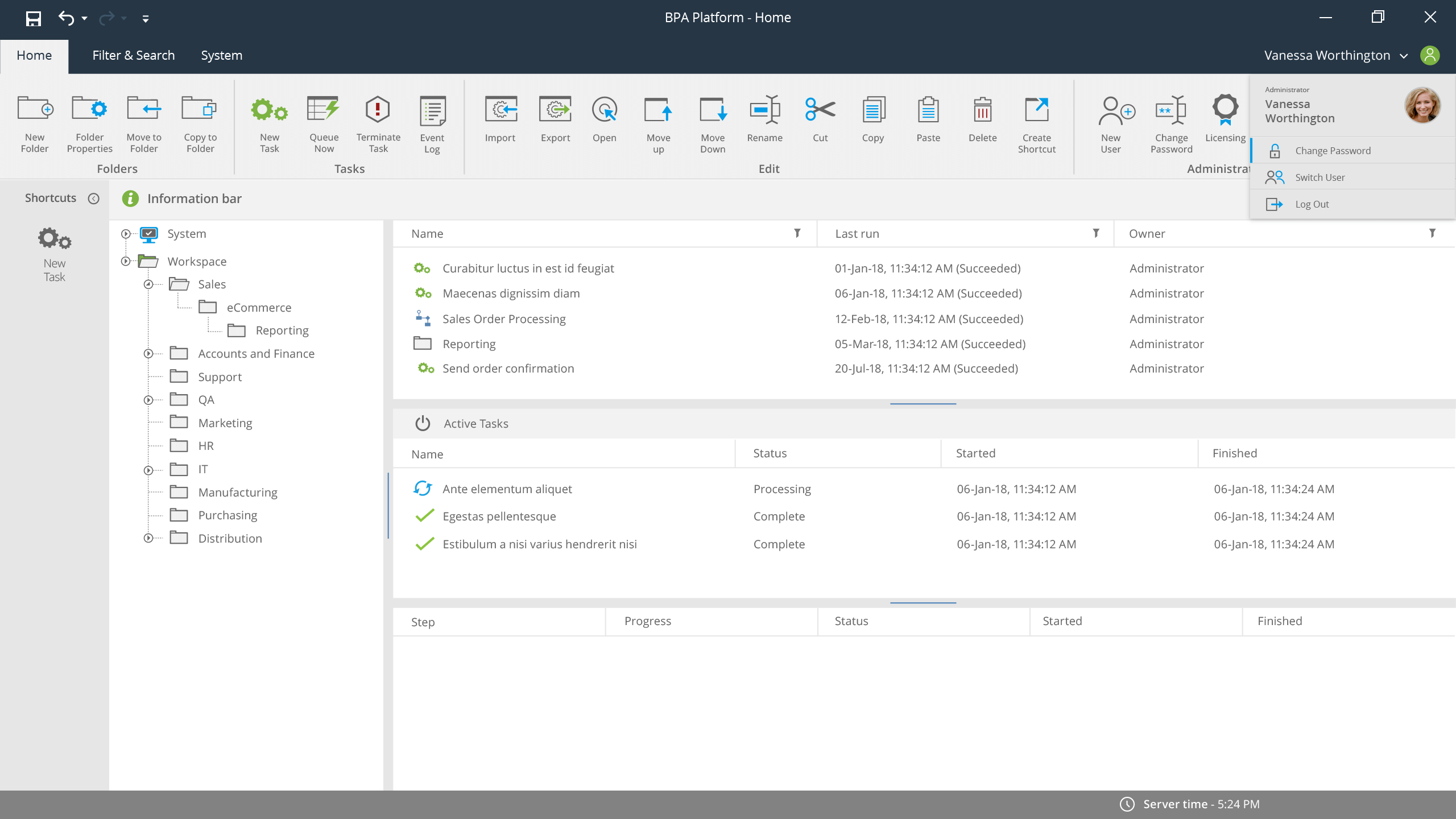
Image: Magento Order Management Example: Sales Order Being Processed
Specialist Magento integration tools, such as Codeless Platforms’ BPA Platform, provide a dedicated Magento connector that simplifies access to the Magento REST API. Once installed, additional integrations can be added. This can be achieved through either templated solutions that require minimal configuration or by utilising the power of its drag and drop tools to interact with data sources via ODBC, OLEDB, web services or an extensive range of supported third-party APIs through connectors.
Its ability to integrate with a variety of ERP systems and practically any data source to automate business processes through a drag and drop graphical user interface provides a significant reduction in software development times and costs.
Its Magento ERP integration tools provide a building platform of integration templates that can be quickly and easily configured to both ERP and Magento end points. Once configured, tasks and processes can be easily adapted and customised with data transformation and database triggers to automate a specific eCommerce process unique to your organisation, as and when business needs change.
Key features of Prebuilt Magento connectors:
- Fast and cost-effective implementation
- Vendor support and regular updates
- Standardised data synchronisation for common business scenarios
Considerations:
- May not cover every unique business process
- Additional integrations and automation will require aditional customisation
- Ideal for businesses with standard integration requirements or limited technical resources
Integration Platform as a Service (iPaaS) solutions
iPaaS solutions are cloud-based platforms that facilitate integration between Magento and ERP systems using prebuilt connectors, data transformation tools, and orchestration capabilities. These platforms act as intermediaries, managing data flow and synchronisation across multiple applications.
Integration Platform as a Service solutions like Codeless Platforms’ BPA Platform offer a flexible, scalable way to connect Magento with a wide range of ERP systems. BPA Platform can be deployed in cloud, hybris or on-premises IT environments and provides a suite of prebuilt templates and tools that automate essential eCommerce processes, such as synchronising customer accounts, orders, inventory, pricing, and product data between Magento and your ERP. This automation reduces manual administration, minimises errors, and ensures that business-critical information is always up to date across both platforms.
With BPA Platform, businesses benefit from scheduled and event-driven data synchronisation, including frequent updates for inventory and pricing, daily product catalog refreshes, and real-time order processing. The platform also features robust alerting and notification capabilities, so any integration issues are quickly identified and addressed. Its modular, template-driven approach allows for rapid deployment and easy customisation to fit specific business requirements, making it a strong choice for organisations looking to streamline operations and scale efficiently without heavy IT overheads.
Key features of iPaaS:
- Drag-and-drop interface for easy configuration
- Scalable and flexible for growing businesses
- Centralised monitoring and management of integrations
Considerations:
- Dependent on the reliability and capabilities of the iPaaS provider
- May have limitations in customisation for highly specialised needs
- Suitable for businesses seeking scalable, cloud-based integration with minimal IT overhead
Comparison Table: Magento ERP Integration Methods
| Method | Flexibility | Deployment Speed | Maintenance | Best For |
|---|---|---|---|---|
| Point-to-Point | Moderate | Moderate | In-house | Small businesses, simple integrations |
| Custom Integration | High | Slow | In-house | Complex, unique, or legacy requirements |
| Prebuilt Connector | Moderate | Fast | Vendor-supported | Standard needs, quick deployment |
| iPaaS Solution | High (with limits) | Fast | Vendor-supported | Multi-system, scalable, cloud-first needs |
The main methods for integrating Magento with an ERP system, point-to-point integration, custom integrations, prebuilt connectors, and iPaaS solutions all rely on API-based communication to ensure accurate and efficient data synchronisation. The best approach depends on your business’s size, complexity, technical resources, and long-term growth plans.
What data can be synchronised between Magento and ERP?
Magento and ERP systems can synchronise a broad array of business critical data, such as customer records, product information, inventory levels, orders, and shipping details. Magento integration streamlines business operations, enhances data accuracy, and boosts overall efficiency by ensuring both platforms always reflect the latest information.
Magento integration enables businesses to automate the order management process without employee intervention. It helps to improve the speed of order processing and delivery, as well as reduces operational and fulfilment costs. Magento integration synchronises data between your Magento store and other business systems, such as ERP, CRM, WMS, procurement software, product information systems and courier services.
The most common Magento automation scenarios requested by organisations looking to streamline their eCommerce process include:
| Data Type | Examples of Synchronised Fields |
|---|---|
| Customer Info | Name, email, addresses, order history |
| Product Data | SKU, name, description, price, categories |
| Inventory | Stock levels, restock, warehouse location |
| Orders | Order details, status, invoices, payments |
| Shipping | Methods, tracking, delivery status |
| Financial | Invoices, payments, tax data |
| Additional | Promotions, suppliers, analytics |
Here’s a more detailed breakdown:
Automatically manage customer accounts: Automatically create and update customer accounts (details, billing/shipping address) in an ERP system from sales orders received through Magento. This includes new accounts, guest accounts and existing customer accounts.
Automate Magento order management and processing: Once a customer has checked out with a valid payment transaction, automatically download orders and include key information, such as product description, product code and quantity required, customer billing / shipping details, delivery method (including carriage charges) and method of payment.
Automatic sales order status updates: Automatically create and send order status updates from an ERP system to a Magento eCommerce platform.
Automatically create AR invoices and payments.
Automated inventory updates: When changes in inventory are identified in an ERP system, inventory levels will automatically be updated on the Magento store every 15 minutes.
Automatic Magento pricing updates: Automate the update of retail price changes in Magento on a scheduled basis.
Automatic product updates: Product synchronisation will be performed daily out of normal working hours to make sure all product details are up to date in Magento and any new products are uploaded when added to an ERP systems item master catalogue. When a product is unavailable it will be obscured on the web shop. Product SKU*, description, tax class, weight, retail price and on hand inventory quantity are uploaded.
As a top-level eCommerce integration, the above automated processes can be adjusted to suit exact business requirements. Additional integrations and automated processes can be added, such as courier service automation, automated pick lists, dispatch note creation, automated bank reconciliation, purchase order automation and shipping notifications.
Why should you automated this data?
- Streamlines Operations: Reduces manual data entry and administrative overheads.
- Improves Data Accuracy: Ensures both systems reflect the latest information, reducing errors, product stockouts and shipping delays.
- Enhances Customer Experience: Provides up-to-date product availability, order status, and accurate pricing.
- Supports Business Growth: Enables real-time decision-making and efficient scaling as your business expands.
What are the benefits of integrating Magento with an ERP system?
Integrating Magento with an Enterprise Resource Planning (ERP) system delivers a wide range of advantages, such as optimising business operations, increasing data accuracy, and elevating the customer experience. By automating essential processes including inventory management, order fulfillment, and financial reporting this integration boosts efficiency, minimises manual data entry errors, and supports business growth.
A manual eCommerce process takes time, is prone to errors and can slowly eat away at the profitability of increasing sales numbers. Magento integration with ERP alleviates the processing pains by automating manual, bi-directional tasks between systems. Removing the manual interaction from employees processing data will streamline the Magento order management process, improve business efficiency and enhance customer satisfaction.
Common commercial benefits that organisations of all sizes can achieve through integrating ERP with Magento include:
1. Streamlined Operations and Automation
Automates repetitive tasks like order processing, inventory updates, and customer data management, freeing up staff to focus on strategic activities.
Reduces manual data entry, which lowers the risk of human error and accelerates business workflows.
2. Improved Data Accuracy and Real-Time Synchronisation
Ensures that inventory levels, sales, and customer information are always up to date across all systems, preventing stockouts, overselling, and data discrepancies.
Real-time data synchronisation enables accurate demand forecasting and better decision-making.
3. Enhanced Customer Experience
Provides customers with accurate product availability and order status, leading to higher satisfaction and loyalty.
Enables faster order fulfillment and personalised service by centralising customer data.
4. Cost Optimisation and Increased Efficiency
Reduces operational costs by removing redundant systems and manual processes.
Automates financial reporting, invoicing, and shipping, which improves resource allocation and profitability.
5. Scalability and Flexibility
Supports business growth by handling increased order volumes, multiple sales channels, and expanding product lines without sacrificing performance.
Adapts to changing business needs with customizable workflows and integration options.
6. Data-Driven Decision Making
Consolidates data from various sources, providing advanced analytics and reporting to inform strategic decisions.
Helps identify trends, optimise pricing, and improve customer retention through actionable insights.
Summary Table: Key Benefits of Magento ERP Integration
| Benefit | Description |
|---|---|
| Streamlined Operations | Automates tasks, reduces errors, and improves efficiency |
| Real-Time Data Sync | Keeps inventory, orders, and customer data up-to-date |
| Enhanced Customer Experience | Faster fulfillment, accurate info, and personalised service |
| Cost Optimisation | Cuts operational costs and improves resource use |
| Scalability | Supports growth and multi-channel expansion |
| Data-Driven Decisions | Advanced analytics for better business strategies |
Magento ERP Integration Challenges
What are the most common challenges in Magento ERP integration?
Integrating Magento with an ERP system often presents challenges such as data inconsistencies, complex data mapping, integration downtime, and security concerns. Additional complexities can arise when synchronising large product catalogs, managing multiple stores, and handling custom business logic. Slow API performance, especially during bulk data transfers and conflicts with Magento extensions are also frequent issues that can disrupt seamless integration.
Key Magento ERP Integration Challenges
1. Data Inconsistencies and Synchronisation Issues
- Mismatched or incomplete data between Magento and ERP can lead to inventory discrepancies, order errors, and customer dissatisfaction.
- Differences in data formats, field lengths, or attribute structures require thorough data mapping and validation to ensure consistency.
2. Complex Data Mapping
- Mapping fields for products, customers, and orders between Magento and ERP systems can be complicated, especially when custom attributes or extensions are involved.
- Custom attribute management and handling unique business rules often require specialist configuration and ongoing maintenance.
3. Integration Downtime and System Maintenance
- Scheduled maintenance or unexpected downtime in either system can halt data synchronisation, causing delays in order processing and inventory updates.
- Lack of automated monitoring can result in unnoticed failures, escalating into larger operational issues.
4. Security and Compliance Concerns
- Secure data transmission is essential to protect sensitive customer and business information.
- Ensuring compliance with data protection regulations and implementing robust authentication and encryption protocols are critical for safe integration.
5. Performance Bottlenecks and API Limitations
- Slow API response times, especially during bulk data transfers or catalog updates, can delay synchronisation and impact business operations.
- Server memory limits, timeouts, and inefficient API queries can cause partial updates or failed transactions.
6. Extension and Customisation Conflicts
- Magento extensions that add or modify data fields may not be mapped correctly to the ERP, leading to gaps in data transfer and reporting inaccuracies.
- Customisations in either system can introduce compatibility issues, requiring regular updates and testing to maintain integration stability.
7. Managing Large Product Catalogs and Multiple Stores
- Synchronising thousands of SKUs or managing data across multiple Magento stores increases the complexity and risk of errors.
- Batch processing and optimised synchronisation schedules are often needed to handle high data volumes efficiently.
8. User Training and Adoption
- New integration features and workflows may confuse users, leading to resistance or improper system use.
- Comprehensive training and ongoing support are necessary to ensure successful adoption and utilisation of the integrated solution.
Summary Table: Magento ERP Integration Challenges
| Challenge | Description |
|---|---|
| Data Inconsistencies | Mismatched or incomplete data between systems |
| Complex Data Mapping | Difficulties aligning fields and attributes |
| Integration Downtime | Disruptions due to maintenance or failures |
| Security Concerns | Risks related to data protection and compliance |
| Performance Bottlenecks | Slow API responses and bulk data transfer issues |
| Extension Conflicts | Incompatibilities with Magento extensions or customisations |
| Large Catalogs & Multi-Store | Complexity in syncing high volumes and multiple stores |
| User Training & Adoption | Challenges in onboarding and ongoing user support |
Best Practices to Overcome Magento Integration Challenges
- Thorough Data Mapping and Validation: Ensure all fields and attributes are correctly mapped and validated before integration.
- Incremental Implementation: Start with core functionalities and scale gradually to minimise disruption and downtime.
- Regular Testing and Monitoring: Continuously test and monitor integration performance to identify and resolve issues promptly.
- User Training and Support: Invest in comprehensive training and provide ongoing support to maximise user adoption and efficiency.
- Leverage Standard Connectors and Middleware: Use proven connectors and integration platforms to streamline data synchronisation processes and reduce custom development needs.
By understanding and proactively addressing these common challenges, businesses can achieve a successful Magento ERP integration that supports operational efficiency and improves data accuracy.
Magento ERP Integration Services
Codeless Platforms specialises in eCommerce ERP integration and provides cost-effective and market leading Magento integration services through its drag and drop business process automation and system integration solution, BPA Platform.
With 25 years’ of experience in ERP integration and business process automation, Codeless Platforms has established itself as a specialist in providing robust ERP and Magento integration services. Our flagship product, BPA Platform is a powerful Integration Platform as a Service (iPaaS) and business process automation solution that offers a comprehensive solution for businesses looking to streamline their eCommerce processes and enhance customer relationships through seamless Magento ERP integration.
Our extensive range of Magento ERP integration connectors and solutions provides a building platform of integration templates that can be quickly and easily configured to both ERP and Magento end points. This allows businesses to automate workflows and reduce manual administration effectively. This approach not only accelerates deployment but also supports ongoing customisation as business requirements change.
We pride ourselves on working closely with ERP vendors and channel partners to deliver successful integrations and exceptional customer service. With over 450 partners and 7000 implementations globally, this collaborative approach ensures that each solution is tailored to meet the unique needs of our clients, maximising the value of their ERP and eCommerce investments.
BPA Platform offers cloud-based iPaaS (Integration Platform as a Service), hybrid or on-premises deployment options, providing flexibility to suit different business environments. Our platform excels in data integration, offering robust tools for data cleansing, transformation and synchronisation across multiple systems.
Key features of our ERP integration services include:
- Bi-directional data synchronisation
- Automated workflow and approval processes
- Automated alerts and notifications
- Drag and drop functionality to build automated processes and integrations
- Data transformation functions to change data between input and output
- Access to hundreds of data connectors via an easy-to-use platform
- Scalable solutions to scale integrations and automations up or down depending on business needs
- Business process automation tools as standard
- Comprehensive security and compliance measures
Whether you are a Magento or ERP user or an ERP reseller, when using Codeless Platforms’ BPA Platform for Magento ERP integration you will achieve significant cost savings and productivity gains throughout your business.
Automating business processes requires a solid understanding of data and a comprehensive knowledge of source or target applications. Codeless Platforms has a proven track record in deploying ERP integration solutions, and has accredited partner status with well-known ISVs, such as SAP, Microsoft, SYSPRO and Sage, along with industry-specific applications and systems in many economic regions.
Through collaboration with ISVs and leading channel VARs, specialist features have been built into BPA Platform to provide you with an end-to-end automated business. This provides organisations with the ability to create a solution that is completely personalised to their internal applications and business operations.
Codeless Platforms’ professional services team can help you to plan your Magento ERP integration project and execute solutions that are a 100% fit every time. Our Professional Services team provides direct implementation and expert services essential to getting solutions up and running quickly and correctly so that you can achieve additional value from your business systems as soon as possible.
For more information on how you can integrate Magento with your ERP system and other on-premises or cloud-based business applications, download the brochure below, or call us on +44 (0) 330 99 88 700.