

What is ERP eCommerce integration?
ERP eCommerce integration refers to the seamless connection between a company’s eCommerce platform and its ERP system.
An ERP (Enterprise Resource Planning) system manages core business processes such as inventory, order fulfilment, accounting, procurement, and customer relationship management. By integrating these systems, businesses can synchronise data in real time, eliminating the need for manual entry and reducing errors across departments.
For example, when a customer places an order on an eCommerce website, an integrated ERP system can automatically update inventory levels, generate an invoice, initiate order fulfilment, and even update financial records, without any human intervention. This level of automation creates a streamlined, unified workflow that saves time, cuts costs, and improves accuracy.
Because ERP and eCommerce integrations often touch multiple processes at once, from order-to-cash and fulfilment to finance and customer service, they are most effective when planned as part of a wider digital transformation roadmap. This ensures integrations scale with the business without creating technical debt or operational bottlenecks.
Why it matters in today’s digital commerce environment
Consumer expectations have evolved. Today’s shoppers demand instant updates on product availability, accurate shipping timelines, and personalised experiences. At the same time, businesses are managing increasingly complex operations, from omnichannel sales to global logistics.
Relying on siloed systems and manual processes can lead to data inconsistencies, fulfilment delays, and poor customer service, all of which damage brand reputation and profitability.
eCommerce ERP integration bridges this gap by creating a centralised system of truth. It empowers businesses to scale efficiently, respond quickly to market demands, and make data-driven decisions based on real-time insights.
Whether you’re a mid-sized retailer or a growing manufacturer, integration is not just a tech upgrade, it’s a strategic move toward long-term digital transformation.
The role of eCommerce in modern business
The way people shop has undergone a radical transformation in the past decade. Traditional brick-and-mortar stores are now just one part of a much broader retail ecosystem.
Today, businesses are expected to be available wherever their customers are, whether online, on mobile apps, in marketplaces, and even on social media platforms. This shift has made eCommerce a central pillar of modern business strategy.
Rise of omnichannel retail
Omnichannel retail refers to the seamless integration of multiple shopping channels, including physical stores, websites, mobile apps, social media, and marketplaces like Amazon or eBay, to deliver a unified customer experience. Instead of treating each channel as a separate entity, omnichannel businesses ensure consistency in pricing, product availability, branding, and customer service across all platforms.
This evolution is driven by changing consumer behaviour. Shoppers now research products online, compare prices on mobile devices, purchase in-store, and expect customer support via chat or email, all within the same buying journey.
Retailers that embrace an omnichannel approach tend to enjoy higher customer loyalty, better data visibility, and improved sales performance.
However, the complexity of managing operations across multiple touchpoints increases significantly. That’s where eCommerce integration with backend systems like ERP come into play.
eCommerce platforms overview
There are several popular eCommerce platforms available today, each offering unique features to support a variety of business needs:
- Shopify: Known for its ease of use and fast setup, Shopify is a hosted platform ideal for small to mid-sized businesses. It offers a wide range of apps and themes and is scalable enough for growing brands.
- Magento (Adobe Commerce): A powerful, open-source solution preferred by larger or more technically advanced businesses. Magento offers deep customisation, advanced inventory options, and support for B2B and B2C models.
- WooCommerce: A WordPress-based plugin that turns a website into a full-featured online store. WooCommerce is highly flexible, making it a favourite for content-driven brands or businesses already using WordPress.
Each platform has strengths, but they all share a common challenge: the need to sync critical business data, such as inventory, orders, pricing, and customer information, with internal systems. Without integration, businesses risk running on fragmented data, which leads to errors and inefficiencies.
Why integrate eCommerce with ERP systems?
As businesses scale and customer demands become more complex, the disconnect between front-end eCommerce operations and back-end systems can create serious inefficiencies.
Integrating your ERP system with your eCommerce platform helps bridge this gap, providing a single source of truth for all business-critical data. The result? A more agile, efficient, and responsive organisation.
Benefits for inventory, order, and customer data management
- Accurate inventory tracking
Integration ensures that stock levels are updated in real time across all sales channels. This helps prevent overselling, stockouts, and customer dissatisfaction. Whether an order is placed online, in-store, or through a marketplace, your ERP can reflect the change instantly. - Streamlined order processing
With integration, every online order flows directly into your ERP system for fulfilment with no manual data entry required. This speeds up the processing cycle, reduces human error, and improves order accuracy. It also helps automate picking, packing, and shipping steps. - Unified customer data
Customer profiles, order histories, payment preferences, and shipping details are consolidated across systems. This allows marketing, sales, and support teams to provide a personalised and consistent experience, which is crucial for building loyalty and increasing lifetime value. - Improved financial visibility
Integrated systems automatically sync sales data, taxes, and returns with your accounting modules. This enhances financial reporting, budgeting, and compliance, while reducing the risk of discrepancies during audits.
Streamlining operations and improving customer experience
Beyond backend efficiency, ERP eCommerce integration has a direct impact on customer satisfaction:
- Faster fulfilment: Orders are processed and shipped quicker with fewer errors.
- Accurate product availability: Real-time updates ensure customers can see what’s actually in stock.
- Transparent communication: Automated updates about order status, tracking numbers, and return processing enhance trust.
- Scalable operations: As order volumes grow, automation ensures your team can handle the increase without hiring a large operations staff.
In essence, integration reduces friction, both internally and externally. It empowers your team to focus less on fixing problems and more on growth strategies, customer engagement, and product innovation.
How ERP-integrated eCommerce works
ERP-integrated eCommerce is more than just a data pipeline, it’s a dynamic, real-time connection between your online store and the core of your business operations. When implemented correctly, this integration allows for smooth data flow, automation, and accuracy across departments such as sales, inventory, finance, and customer service.
Below, we explore how this integrated ecosystem functions by examining five core processes:
1. Data synchronisation
At the heart of ERP eCommerce integration is data synchronisation. This process ensures that key business data, such as product listings, pricing, inventory levels, and customer profiles, remains consistent and up to date across systems.
Without integration, eCommerce and ERP systems operate in silos, requiring manual data entry to keep records aligned. This not only wastes time but also introduces errors and discrepancies. With integration, data entered or updated in one system automatically reflects in the other. For example:
- A new product added in the ERP system appears on the eCommerce storefront within minutes.
- Changes in pricing or descriptions in the ERP sync directly to the product pages.
- Customer details captured during checkout flow back to the ERP, creating or updating customer profiles.
This continuous, bi-directional sync improves efficiency and ensures that your business operates from a single source of truth.
2. Real-time inventory updates
Inventory management is one of the most critical aspects of any retail or distribution business. In an ERP-integrated eCommerce setup, inventory levels are updated in real time, reducing the risk of overselling and ensuring that stock visibility is always accurate.
When a purchase is made on your eCommerce platform, the ERP system immediately adjusts the available inventory. Conversely, if inventory changes in the warehouse (due to restocking, returns, or offline sales), those changes are instantly reflected online.
Benefits include:
- Preventing stockouts and backorders
- Minimising lost sales due to inventory mismatches
- Enhancing customer trust with reliable availability information
This is especially crucial for businesses operating across multiple channels (e.g., physical stores, online marketplaces, and B2B portals), where inventory accuracy must be maintained universally.
3. Automated order fulfilment
Order fulfilment is where integration really has a significant impression by eliminating manual tasks and accelerating delivery times. Once a customer places an order on the eCommerce site, the details are automatically pushed to the ERP system.
From there:
- A sales order is created in the ERP
- The system generates a pick-list for warehouse staff
- Shipping labels and invoices may be automatically produced
- The inventory is adjusted, and fulfilment status is updated
Once the order is shipped, the ERP system sends tracking information and shipping confirmation back to the eCommerce platform, triggering an automated notification to the customer.
This closed-loop process:
- Reduces errors and delays
- Increases fulfilment speed
- Provides customers with timely updates, enhancing satisfaction
Advanced ERP systems also support features like partial shipments, drop-shipping, and backorders, all of which can be handled seamlessly through the integration.
4. Financial transactions and accounting
One of the most overlooked yet vital aspects of ERP-integrated eCommerce is the automatic handling of financial transactions. Every order, return, tax charge, discount, and shipping fee must be accurately recorded in your accounting system for compliance, reporting, and decision-making.
With integration:
- Sales invoices are automatically generated in the ERP
- Payments collected through the eCommerce platform are matched with orders
- Taxes are calculated and recorded according to the customer’s location
- Refunds and returns are posted to the correct accounts
This ensures that your books are always up to date and reduces the need for double data entry or spreadsheet-based reconciliation. For growing businesses, this capability becomes crucial for scaling operations and preparing for audits or investment.
5. Customer relationship management (CRM)
A connected ERP-eCommerce environment enables a 360-degree view of the customer, allowing your business to deliver better service and more targeted marketing.
Here’s how it works:
- When a customer places an order, their information is captured and synced to the ERP system.
- Support teams can view order history, communication logs, and support tickets in one place.
- Sales reps can use ERP data to upsell or cross-sell based on purchase behaviour.
- Marketing teams can launch personalised campaigns based on data such as frequency of purchase, average order value, and browsing behaviour.
Consolidating data into one system will enable your team to offer a more consistent and personalised experience across all touchpoints, from website interactions to post-sale support.
Using the BPA Platform API with eCommerce Webhooks
Real-world ERP eCommerce integration examples
Amazon SYSPRO integration

ATTITUDE, a Canadian company based in Montreal that develops natural personal care and household products, deployed BPA Platform to remove the manual processing of B2B and B2C sales orders from Amazon and its Shopify website to SYSPRO. The integration of Amazon and Shopify with SYSPRO, and the subsequent automation of its sales order processes, has completely transformed ATTITUDE’s business operations, providing the business with the foundation to continue its rapid growth.
“As Amazon is one of our main customers, the automation was absolutely necessary. BPA Platform now automates all of the EDI messages from Amazon including the creation of new sales orders, shipments, advanced shipping notifications, and invoices. So that’s made a huge difference. We are also using BPA Platform to connect Shopify with SYSPRO, and to automatically download invoices and create sales orders directly into SYSPRO on a daily basis.”
Nicolas Wendling, Director of Operations, ATTITUDE
Shopify Warehouse Management integration

French Connection, a UK-based global retailer and wholesaler of fashion clothing, accessories and homeware, successfully integrated its four Shopify Plus websites (French Connection UK, US and EU, and Great Plains) with its bespoke customer service and warehouse fulfilment solution, Options, using BPA Platform.
“Replacing a successful, busy eCommerce site with a new technology like Shopify was always going to be complex. Doing it for four busy sites could easily have become a multi-year project. However, using BPA Platform enabled us to reduce this time and meet our deadlines. The flexibility of the solution really highlighted the power of BPA Platform. The solution gives us the scope to continue to improve our business processes. We are already discussing the different ways we can further utilise BPA Platform in the future.”
Vim Juneja, Global Head of IT, French Connection
eCommerce Microsoft Dynamics AX integration

inov-8, a footwear, clothing and equipment brand for committed trail and off-road runners, fitness athletes and adventure-seeking hikers, improved its sales order processing having deployed BPA Platform for order fulfilment automation and synchronising data between its eCommerce channels, courier services and Microsoft Dynamics AX. This has resulted in operational efficiency, as well as laying the foundations for future developments. inov-8 was so comfortable using BPA Platform that everything was managed in house.
“We needed a solution to deliver an end-to-end solution for our eCommerce service and BPA Platform has allowed us to achieve that. Within the BPA Platform middleware, the Web Service Connector Tool is a great mapping tool for easily being able to transform data between two different sources. We also find the Scheduler Tool and the Call Task function quite useful for converting data sets to XML or XML to data sets. We’ve found it to be quite a powerful tool. We originally used it to connect our eCommerce and courier systems, but we have used it for other sales channels since then, including our B2B portal.”
Jonathan Emerson, Head of IT, inov-8
Shopify SYSPRO integration

United Pacific Industries, a privately owned Australian healthcare company, deployed BPA Platform as the integration and business process automation solution between Shopify and SYSPRO. This has not only reduced the amount of manual data processing that would have been required, it has also enabled United Pacific Industries to realise its new business strategy much faster than was expected.
“BPA Platform is automatically pulling through all of the new direct consumer orders from the website into SYSPRO. That has removed a lot of the manual work that was occurring. Without connecting SYSPRO to these new websites, we may not be where we are today. BPA Platform basically sped up the ability to launch our website. We’re also looking at adding a wholesale portal on the new website that we’ve launched. BPA Platform is opening more doors for us.”
Fenella Brown, Marketing Manager, United Pacific Industries
Magento Access Dimensions integration

Videcon Ltd., a leading trade-only distributor of security products and services, improved its sales processes and future-proofed its systems by deploying BPA Platform to integrate Magento with Access Dimensions. The company subsequently automated the updating of stock items, inventory, sales orders, pricing matrixes and invoices/estimates.
“We introduced BPA Platform to create the link between Access Dimensions and Magento. It is definitely going speed up the process of sales – it’s a lot less man hours this way. It also makes it much more streamlined for the customer. As we are a B2B organisation it has helped with out-of-hours service, especially for our customers as they are able to quickly check a price to put a quote together. Previously, the only way that they could access the pricing was to give us a call. Now they can go online, get the pricing and put their own quote together.”
Lindsay Phillips, Marketing Manager, Videcon
Common challenges in eCommerce ERP integration
While ERP eCommerce integration offers significant benefits, it’s not without its challenges. Businesses often underestimate the complexity of syncing two powerful systems that manage critical operations. Identifying and addressing these challenges early can prevent costly disruptions and project delays.
Data synchronisation issues
One of the biggest hurdles is ensuring consistent and accurate data flow between systems. Discrepancies in inventory counts, customer details, or pricing data can lead to:
- Confused customers
- Delayed orders
- Internal reporting errors
Inconsistent data structures or naming conventions between platforms can cause misalignment unless standardised during integration. Frequent product updates, returns, and promotions also increase the volume and variability of data, making data synchronisation more difficult without the right tools in place.
Customisation complexity
ERP systems are often highly customised to match specific business processes, especially in larger organisations. Unfortunately, this customisation can create integration difficulties when attempting to map eCommerce data fields or workflows.
For example:
- Custom pricing rules may not easily align with eCommerce discount engines.
- Unique order routing logic might not be supported by the standard eCommerce platform.
This often necessitates custom development or middleware, increasing both time and cost.
Real-time updates vs. batch processing
Not all integrations operate in real time. Some businesses rely on batch updates, where data is synced every few hours rather than instantly. While this may work for low-volume operations, it introduces problems in fast-paced environments where:
- Inventory sells out quickly
- Orders need same-day fulfilment
- Customers expect real-time updates
Choosing between real-time and batch processing is often a balancing act between performance, cost, and technical capability.
Security and compliance
Integrating two core systems increases the surface area for data breaches and compliance violations. Customer data, payment information, and internal records must be securely transmitted and stored, especially under regulations like GDPR or PCI DSS.
Without careful planning, businesses risk exposing sensitive information or falling out of compliance during data transfer.
Despite these challenges, many companies successfully implement ERP eCommerce integrations by choosing the right strategy and tools from the outset.
Integration methods and tools
Successfully connecting your ERP and eCommerce systems requires a thoughtful approach to integration. Depending on your business size, technical resources, and platform flexibility, you have several options, each with its own pros and cons.
API-based integration
APIs (Application Programming Interfaces) are one of the most modern and flexible ways to integrate ERP and eCommerce platforms. They allow systems to communicate in real time, enabling two-way data exchange for orders, inventory, customer data, and more.
Advantages:
- Real-time synchronisation
- High flexibility and scalability
- Supports automation and custom workflows
Drawbacks:
- Requires development expertise
- Can be expensive if custom-built from scratch
This method is ideal for businesses that need a tailored integration or already have in-house developers.
Middleware solutions
Middleware, such as BPA Platform, acts as a bridge between your ERP and eCommerce systems. These third-party platforms handle the data translation, mapping, and syncing, so your core systems don’t have to change.
Advantages:
- Faster deployment compared to custom APIs
- Less strain on internal development teams
- Built-in connectors for popular ERP and eCommerce systems
Drawbacks:
- Additional cost for licenses
- May not support complex or unique business logic out of the box
Middleware is great for mid-sized businesses that want reliability without investing in heavy custom development.
Custom connectors and third-party plugins
Many eCommerce platforms (like Shopify, Magento, or WooCommerce) offer pre-built connectors or extensions for specific ERP systems. These are plug-and-play solutions that can drastically reduce setup time.
Advantages:
- Cost-effective and quick to deploy
- Minimal development needed
- Supported by vendor communities
Drawbacks:
- Limited customisation
- May not scale well with business complexity
- Risk of vendor lock-in or lack of support over time
Choosing the right integration method depends on your specific needs: the complexity of your operations, your budget, and how critical real-time data is to your business. The next section will dive into the key features you should look for when evaluating any ERP eCommerce integration solution.
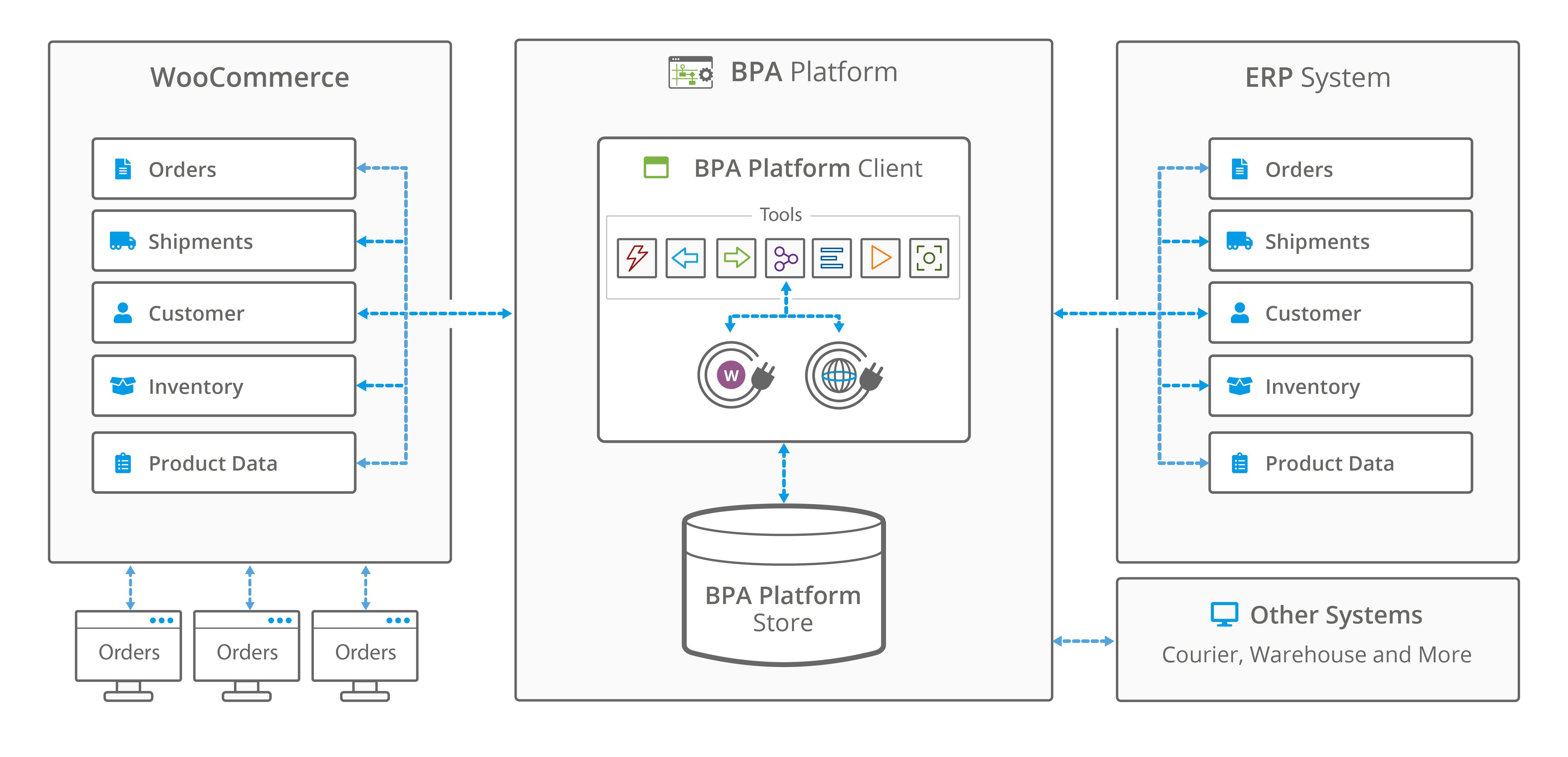
Image: WooCommerce integration with ERP using BPA Platform
Key features to look for in an ERP eCommerce integration solution
The right ERP eCommerce integration solution should go beyond basic data syncing and support the depth and complexity of your business operations. Whether you’re evaluating vendors, plugins, or building a custom integration, here are the must-have features to look for:
1. Real-time inventory updates
Customers expect accurate stock information when browsing your store. Real-time inventory syncing ensures that product availability on your eCommerce site reflects actual ERP stock levels, preventing overselling, backorders, and customer frustration.
Bonus: Look for support for multi-location inventory if you fulfil from multiple warehouses or retail stores.
2. Automated order processing
Once an order is placed, it should flow instantly into your ERP system for picking, packing, and shipping. Automation reduces manual input, speeds up fulfilment, and decreases the likelihood of human error.
Essential capabilities include:
- Syncing order status updates back to the eCommerce platform
- Auto-generating invoices or packing slips
- Supporting split shipments or partial fulfilment
3. Customer data unification
Your ERP system should consolidate customer profiles, order histories, and preferences regardless of where the sale originated. This 360-degree view is critical for personalised marketing, proactive support, and accurate sales reporting.
Pro Tip: Ensure the integration respects data privacy laws and syncs only necessary information.
4. Product Information Management (PIM)
Consistent product data, including descriptions, images, SKUs, and pricing, is vital across all channels. Integration should allow product updates in one system (usually ERP or a dedicated PIM) to reflect automatically on your eCommerce site.
Look for features like:
- Variant and attribute syncing
- Tiered pricing or customer-specific pricing
- Multi-language and multi-currency support
5. Returns and refund synchronisation
Returns and exchanges are part of modern retail. A strong integration should allow return requests from your eCommerce store to flow back into the ERP system, triggering inventory restocks and refunds.
Benefits:
- Faster return processing
- Better inventory accuracy
- Improved customer satisfaction
6. Financial data syncing
Sales data, taxes, discounts, shipping charges, and refunds should all sync seamlessly with your ERP’s accounting module. This eliminates the need for reconciliation between platforms and improves financial accuracy.
Ensure the integration supports:
- Tax rules and compliance by region
- Payment gateway reconciliation
- Multi-currency transactions if applicable
These features ensure that your integration supports long-term scalability, operational efficiency, and a better customer experience.
ROI and digital transformation
As we’ve explored throughout this article, ERP-integrated eCommerce brings immense value by streamlining operations, improving accuracy, and enhancing the customer experience.
Investing in ERP eCommerce integration is a strategic move with high ROI potential. Businesses typically see:
- Lower operational costs due to automation
- Increased revenue through improved fulfilment and customer satisfaction
- Better decision-making with unified, accurate data
But perhaps more importantly, integration lays the foundation for digital transformation. It empowers businesses to scale confidently, adapt quickly to market shifts, and deliver seamless, data-driven experiences that today’s customers expect.
In a landscape where speed, accuracy, and personalisation define success, ERP-integrated eCommerce is not just a tool, it’s a competitive advantage.
Codeless Platforms’ BPA Platform
Codeless Platforms’ BPA Platform offers a robust suite of tools specifically designed to simplify and streamline ERP eCommerce integration.
These tools are modular and low-code, allowing businesses to build scalable, custom workflows without complex programming. Here’s an overview of the key tools and components provided:
1. Data integration and synchronisation tools
At its core, BPA Platform provides data mapping and transformation capabilities that allow seamless synchronisation between eCommerce platforms (such as Shopify, Magento, WooCommerce, BigCommerce) and ERP systems (like SAP Business One, Microsoft Dynamics, Sage, Epicor, SYSPRO, etc.). These tools enable two-way data flow for:
- Orders
- Customers
- Inventory
- Products
- Shipping information
2. Scheduler and trigger tools
Automated scheduling tools let you run tasks at defined intervals or trigger them based on specific events (e.g., new order received, inventory change). This ensures real-time or batch-based syncing between your systems, depending on your operational needs.
3. Task designer
This is the platform’s visual, drag-and-drop interface where users build workflows. You can connect data sources, apply logic, and define actions, such as pushing order data from Magento to SAP Business One or updating inventory across channels, without writing code.
4. Web Services (REST/SOAP/GraphQL) Connector
BPA Platform includes native support for REST, SOAP and GraphQL APIs, allowing it to interact directly with modern eCommerce platforms and cloud services. This is crucial for real-time integrations and custom connectors when working with APIs that are not covered by out-of-the-box connectors.
5. Data format and transformation tools
These allow you to manipulate and convert data into the required format (e.g., XML, JSON, CSV, SQL), ensuring compatibility between systems with different data structures. It helps align ERP records with eCommerce data models effortlessly.
6. Error handling and logging
Robust monitoring, logging, and error notification features ensure issues are detected and resolved quickly. Alerts can be configured to notify stakeholders of failed tasks or data mismatches, which improves reliability and transparency.
7. Secure FTP/email tools
The platform supports file-based integrations where APIs aren’t available, allowing secure file transfer (via FTP/SFTP) of orders, inventory files, and financial data. It can also use email protocols for sending alerts or documents like invoices and shipping notices.
8. ERP and eCommerce connectors
Codeless Platforms provides a growing library of prebuilt connectors and template packs for leading ERP systems and eCommerce platforms. These accelerators help reduce implementation time and ensure best practices are followed out of the box.
- Shopify + Access / Microsoft Dynamics NAV / Sage 200 / SAP Business One / SYSPRO
- Magento + Access / Microsoft Dynamics NAV / Sage 200 / SAP Business One / SYSPRO
- WooCommerce + Access / Microsoft Dynamics NAV / Sage 200 / SAP Business One / SYSPRO
Together, these tools allow businesses to build tailored ERP eCommerce integrations that are efficient, scalable, and maintainable, helping to deliver strong ROI and enabling digital transformation without heavy IT overhead.
Ready to start your integration journey? Discover how BPA Platform can help you simplify ERP eCommerce integration and accelerate business growth. Contact us today or schedule a free demo.