
Why do modern businesses need a flexible integration platform?
Businesses operate in an environment of constant change, where technology must evolve to support growth, efficiency, and competitiveness. A flexible integration platform plays a critical role in supporting system transitions by enabling different applications, databases, and technologies to communicate effectively during periods of change.
This is particularly important when organisations need to switch systems without disrupting day-to-day operations, customer service, or internal workflows.
One key reason businesses require this flexibility is when upgrading systems, whether this involves replacing outdated legacy platforms or implementing a newer version of an existing solution. During these upgrades, integration platforms help ensure that data can move seamlessly between old and new systems, reducing downtime and protecting business continuity.
Another important factor is when an existing system no longer meets business requirements or fails to perform as expected. As organisations grow, their operational needs often become more complex, and older systems may lack the functionality, speed, scalability, or reliability required to support these demands.
Businesses also need integration support when a system or product reaches its end of life. Once vendor support, maintenance, and security updates are discontinued, continuing to use the system can create operational risks and security vulnerabilities, making migration to a new platform essential.
In addition, acquisitions, mergers, or the integration of subsidiaries often bring together organisations that use different systems and technologies. A flexible integration platform helps connect these environments, allowing data sharing, process alignment, and a smoother organisational transition.
Finally, the introduction of new applications and systems to improve business processes, such as CRM, ERP, or automation tools, requires strong integration capabilities to ensure these new technologies work efficiently with existing infrastructure. This allows businesses to innovate while maintaining consistent and reliable operations.
Ultimately, without a flexible integration platform, such as BPA Platform, organisations lose the freedom to evolve their systems efficiently. This leads to higher switching costs, slower adoption of better technologies, and reduced competitiveness in a rapidly changing digital landscape.
Article summary: A flexible integration platform is essential for businesses looking to stay agile in a rapidly evolving technology landscape. Connecting core systems such as ERP, CRM, and eCommerce platforms through a centralised integration layer, such as BPA Platform, enables organisations to reduce complexity, improve data consistency, and switch systems with minimal disruption. This article explores:
- Why businesses need a flexible integration platform and how they can replace ERP, CRM, or eCommerce platforms without rebuilding every integration.
- Key business benefits, such as faster system changes, improved data consistency, reduced IT complexity, and better scalability.
- What to look for in an integration platform such as API-first architecture, security, monitoring, real-time processing, and scalability.
- How Integration Platform as a Service (iPaaS) enables scalable, cloud-based, and low-code integrations.
- Future-proofing business architecture: Why flexible integration platforms help organisations adapt to growth, acquisitions, and evolving technologies.
A flexible integration platform powered by iPaaS allows organisations to build a composable architecture where systems can be swapped in and out, accelerate digital transformation initiatives, and respond quickly to market changes and customer expectations.
“It’s a core part of our infrastructure that we simply rely on. If we lost it, replacing it would take a significant amount of effort, which shows how critical it is to us. While we use it in specific situations, it’s incredibly versatile. You can adapt it to do whatever you need. In our environment, it typically acts as the glue between touchpoints, taking SQL-based inputs and turning them into automated processes. From a value perspective, it consistently reduces development effort by at least 50% in the areas where we use it. It’s stable, reliable, and significantly lowers ongoing maintenance overhead, which delivers real operational savings over time.”
Luigi Salzano, CTO & IT Director, Routes Healthcare
What are the consequences of not having an integration platform?
Building on the importance of a flexible integration platform, the challenges faced by businesses without an integration solution are even more significant.
Without a platform to connect systems, upgrading legacy software or implementing newer versions becomes a complex and error-prone process. Data must often be moved manually or through one-off custom scripts, increasing the risk of errors, operational disruption, and extended downtime. This makes system updates slower, costlier, and far more difficult to manage.
As previously noted, businesses often replace systems because they no longer meet operational requirements or have reached end of life. Without an integration platform, migrating to new solutions can be daunting, as there is no standardised way to transfer data or ensure continuity across applications.
Moving data between systems requires consistent formats and smooth data flows. Without a flexible platform, transferring customer, financial, or operational data between different systems can lead to inconsistencies, data loss, or duplication. This undermines trust in the data and can disrupt business operations.
As a result, organisations may be forced to maintain outdated systems longer than necessary, reducing efficiency and potentially exposing the business to security and compliance risks.
The impact is especially pronounced during mergers, acquisitions, or the integration of subsidiaries with differing systems. Without a central integration layer, connecting disparate platforms requires extensive custom development, delaying process alignment and limiting visibility across the organisation.
Similarly, the introduction of new applications to enhance business processes is slowed or complicated, restricting innovation. In short, operating without an integration platform undermines agility, efficiency, and the ability to respond to change effectively.
“The thing we like about BPA Platform is its flexibility and ease of use. You don’t have to be too technical in order to use the tool. If you want to do business process automation I think BPA Platform is the best tool to use.”
Mansoor Ahmad, IT Consultant, Slendertone
What is a flexible integration platform?
A flexible integration platform is a technology layer that connects all your business applications, such as ERP, eCommerce, CRM, finance, and logistics systems, into a unified, coordinated ecosystem.
Rather than building direct, point-to-point integrations between every pair of systems, each application connects once to the platform, which then manages how data flows between them.
How a flexible integration platform works
Instead of systems communicating directly with one another, they interact through the integration platform using APIs, connectors, or event streams.
This creates a decoupled architecture, where:
- Each system is independently connected to the platform
- Data is routed, transformed, and synchronised centrally
- Changes in one system don’t require widespread reconfiguration
For example, when an order is placed on an eCommerce platform:
- The order data is sent to the integration platform
- The platform transforms the data into the required formats
- It distributes the data to the ERP, CRM, and fulfilment systems simultaneously
All of this happens behind the scenes, often in real time.
“BPA Platform is just an extremely versatile product that helps us solve a wide-range of issues. It’s a tool that we have been using for a long time now and one that we are familiar with. BPA Platform just comes along and manages to fix everything and save the day. It’s a bit like your Swiss Army knife. We are always finding ways for BPA Platform to make life easier for us.”
Steven Oakley, Business Systems Manager, Viadex
Key benefits of a flexible integration platform
System migrations, whether moving to a new ERP, CRM, or eCommerce platform, are often complex, high-risk initiatives. Without the right architecture in place, they can lead to operational disruption, data inconsistencies, and extended downtime. A flexible integration platform, such as BPA Platform. significantly reduces these risks and enables smoother, more controlled transitions.
Let’s take a look at the main key benefits.
Freedom to switch systems
One of the most powerful advantages of a flexible integration platform is the ability to change core business systems without triggering a cascade of rework across your entire technology stack.
In traditional architectures, systems are tightly coupled. For example, your ERP might be directly connected to your eCommerce platform, CRM, warehouse management system, and finance tools. Replacing just one of these systems means rewriting multiple integrations, testing them individually, and managing the risk of breaking critical workflows.
A flexible integration platform decouples these systems. Each application connects to the integration layer rather than directly to one another. This means:
- You only need to update or replace a single connection when switching systems
- Existing workflows and data mappings can often be reused
- Business operations continue with minimal disruption during transitions
This flexibility empowers businesses to choose best-of-breed solutions rather than being locked into a single vendor ecosystem. It also reduces the fear and risk typically associated with system upgrades or migrations.
“BPA Platform is extremely good value for money. In fact, the investment that we made in BPA Platform was probably paid back in the first year. It provided us with a flexible and fully stable integration and business process automation platform that enabled us to connect to a variety of applications and systems that we introduced over the years, without any difficulty. Even when we decided to switch our ERP system to Oracle NetSuite we knew that we could rely on it to deliver the required integration. BPA Platform once again proved to be a great solution – reliable, flexible, and cost-effective.”
Blaise Lester, Group Business Systems Development Manager, Cloud Nine
Faster time to market
Speed is critical in today’s competitive environment. Whether launching a new product, entering a new region, or responding to customer demands, delays in system integration can slow down innovation.
A flexible integration platform accelerates delivery in several ways:
- Pre-built connectors eliminate the need to build integrations from scratch
- Reusable workflows allow teams to replicate successful processes quickly
- Low-code/no-code tools enable non-developers to configure integrations
For example, if a business wants to launch a new eCommerce storefront, the integration platform can quickly connect it to existing inventory, pricing, and customer systems. What might have taken months can often be achieved in weeks, or even days.
This agility allows organisations to experiment more freely, iterate faster, and capitalise on opportunities before competitors do.
Improved data consistency
Data is the backbone of modern business operations, but when systems are poorly integrated, inconsistencies quickly emerge. Customer records may differ between CRM and billing systems, inventory levels may be out of sync between ERP and eCommerce platforms, and reporting becomes unreliable.
A flexible integration platform ensures that data flows consistently and accurately across all systems by acting as a single source of orchestration.
Key improvements include:
- Real-time or near real-time synchronisation, reducing delays in data updates
- Centralised transformation logic, ensuring data is formatted consistently
- Error handling and monitoring, allowing issues to be detected and resolved quickly
This results in a ‘single version of the truth,’ where stakeholders across departments can trust the data they are using. Better data consistency leads to improved decision-making, more personalised customer experiences, and fewer operational errors.
Scalability and future-proofing
As businesses grow, their technology needs evolve. New systems are introduced, transaction volumes increase, and customer expectations rise. Without a scalable integration approach, growth can strain existing infrastructure and lead to performance bottlenecks.
A flexible integration platform is designed to scale alongside your business:
- It can handle increasing data volumes without requiring major redesign
- New systems can be integrated without disrupting existing ones
- Cloud-native platforms can automatically scale resources based on demand
Future-proofing is equally important. Technology is constantly changing, and businesses must be able to adapt without overhauling their entire architecture.
With a flexible integration layer, organisations can:
- Adopt emerging technologies (AI tools, new marketplaces, IoT systems)
- Replace outdated systems incrementally
- Stay aligned with evolving industry standards and customer expectations
This ensures that your technology stack remains an enabler of growth, rather than a barrier.
Reduced IT complexity
Managing integrations in a traditional environment often leads to a tangled web of connections. Each new system adds more complexity, making it harder to monitor, maintain, and troubleshoot issues.
A flexible integration platform simplifies this by centralising integration logic and standardising how systems communicate.
Benefits for IT teams include:
- Fewer point-to-point integrations, reducing architectural complexity
- Centralised monitoring dashboards, providing visibility into all data flows
- Standardised protocols and APIs, improving consistency and maintainability
When something goes wrong, teams can quickly identify where the issue lies, without having to trace it across multiple disconnected systems.
Additionally, governance and security become easier to enforce. Instead of applying policies across dozens of integrations, they can be managed centrally within the platform.
The result is a more efficient IT operation, lower maintenance costs, and more time for teams to focus on strategic initiatives rather than firefighting integration issues.
Speak to an integration architect
Real-world use case
Imagine a retail business running:
- An ERP system for inventory and finance
- An eCommerce platform for online sales
- A CRM for customer data
Without a flexible integration platform, each system must connect directly to the others. If the company decides to replace its eCommerce platform, every integration must be rebuilt.
With a flexible integration platform:
- The ERP and CRM remain connected through the integration layer
- Only the connection to the eCommerce platform changes
- The rest of the ecosystem continues to operate uninterrupted
“The great thing about BPA Platform is that having integrated it with Dynamics Business Central it then opens up opportunities to integrate other areas of our business. For example, our original B2B website was bespoke, but we’re just transitioning over to a Magento-based platform. We’re using BPA Platform to integrate Magento with Microsoft Dynamics Business Central to give us live stock information and all of our attributes. We’ve also implemented an automated storage system in our warehouse. Orders that we take on our B2B website flow into the ERP. The ERP then pushes those orders into AutoStore. From a picking point of view, the speed that we can get through picks has increased, as well as the accuracy. It’s made a huge difference and certainly helped a lot.”
Richard Mantell, CEO, Specialist Sports
What to look for in an integration platform
Choosing the right integration platform is a critical decision that can shape how agile, scalable, and resilient your business becomes. Not all platforms are created equal, and selecting one that aligns with both your current needs and future ambitions is essential.
Below are the key capabilities to evaluate, along with why they matter in practice.
1. API-first architecture
An API-first integration platform is designed around the idea that all functionality and data can be accessed through well-defined APIs.
This is important because:
- APIs provide a standardised way for systems to communicate
- They enable faster and more flexible integrations
- They support modular, composable architectures
With an API-first approach, your integration platform becomes a reusable service layer. New applications can plug into your ecosystem quickly, without requiring custom-built connections each time.
In the long term, this reduces technical debt and makes your architecture far more adaptable.
2. Pre-built connectors
Pre-built connectors are ready-made integrations for commonly used systems such as ERPs, CRMs, eCommerce platforms, and payment gateways.
These connectors:
- Eliminate the need to build integrations from scratch
- Reduce implementation time from months to weeks (or less)
- Lower the risk of errors in data exchange
However, it’s not just about quantity, it’s about quality and relevance. A good platform should offer:
- Connectors for the systems you already use
- Regularly maintained and updated integrations
- Flexibility to customise or extend connectors when needed
This ensures you’re not limited by the platform as your ecosystem evolves.
“The big advantage of BPA Platform was that the Magento connector was already set up. BPA Platform is now automating product and pricing data from Intact iQ to Magento. If a contact gets created in Salesforce, BPA Platform will push that into Intact iQ. BPA Platform also checks Intact iQ every five minutes to see which ones have been recently created. I’d definitely recommend BPA Platform, especially for what you get for the price. It’s certainly a time saver and it just makes sense. Automating our processes has definitely improved our operations.”
Lorcan Worsley, IT, Systems & Processes, Tudor Environmental
3. Low-code / No-code capabilities
Modern integration platforms increasingly offer low-code or ‘drag and drop’ interfaces, allowing users to design integrations using visual tools rather than writing extensive code.
This capability:
- Empowers business users and analysts to contribute
- Reduces dependency on specialised developers
- Accelerates delivery of integration projects
For IT teams, this doesn’t eliminate the need for coding, but it allows developers to focus on more complex, high-value tasks while routine integrations are handled more efficiently.
Look for platforms that strike the right balance between simplicity and control, so both technical and non-technical users can work effectively.
4. Real-time data processing
Real-time data is now essential as customers want instant updates, and businesses need immediate visibility into operations.
An effective integration platform should support:
- Real-time or near real-time data synchronisation
- Event-driven architectures, where actions are triggered automatically
- Streaming capabilities for high-volume data flows
This enables use cases such as:
- Live inventory updates across channels
- Instant order processing and fulfilment
- Real-time customer personalisation
Without real-time capabilities, businesses risk delays, inconsistencies, and missed opportunities.
5. Strong security and governance
As data flows between multiple systems, often across cloud environments, security becomes a top priority.
A robust integration platform should include:
- End-to-end encryption for data in transit and at rest
- Authentication and authorisation controls (e.g. role-based access)
- Audit trails and logging for compliance and traceability
- Data governance policies to ensure proper handling of sensitive information
This is especially important for organisations operating in regulated industries or handling customer data.
Strong governance also ensures consistency. Therefore, integrations are built and managed according to defined standards, rather than becoming chaotic over time.
6. Scalability and cloud-native design
Your integration needs today will not be the same as your needs tomorrow. A platform must be able to grow with your business.
Cloud-native integration platforms offer:
- Elastic scalability, automatically handling spikes in demand
- High availability and reliability, minimising downtime
- Global accessibility, supporting distributed teams and systems
This is particularly important for businesses experiencing rapid growth, seasonal demand fluctuations, or international expansion.
A scalable platform ensures that integration performance doesn’t become a bottleneck as transaction volumes increase.
7. Monitoring, observability, and error handling
Integrations are mission-critical. When they fail, the impact can ripple across your entire business.
That’s why visibility is essential. Look for platforms that provide:
- Centralised dashboards to monitor all integrations
- Real-time alerts and notifications for failures or anomalies
- Detailed logs and diagnostics for troubleshooting
- Automated retry and recovery mechanisms
These capabilities allow IT teams to quickly identify and resolve issues, often before they affect customers or operations.
In mature platforms, observability goes beyond monitoring to provide insights into performance trends and optimisation opportunities.
8. Flexibility and extensibility
No platform will perfectly match every business requirement out of the box. The ability to extend and customise is crucial.
A flexible integration platform should allow you to:
- Build custom connectors for niche or legacy systems
- Extend workflows with custom logic or scripts
- Integrate with emerging technologies and services
This ensures that the platform adapts to your business, not the other way around.
9. Vendor ecosystem and support
Finally, consider the broader ecosystem around the platform.
A strong vendor offering includes:
- Active community and knowledge resources
- Regular product updates and innovation
- Reliable customer support and onboarding assistance
- Partnerships with other technology providers
This can significantly impact how quickly your team becomes productive and how well the platform continues to meet your needs over time.
Bringing it all together
Selecting an integration platform is not just about ticking feature boxes, it’s about enabling long-term agility.
The right platform will:
- Simplify how your systems connect
- Empower teams across the business
- Scale with your growth
- Reduce risk and operational complexity
Ultimately, it should serve as a foundation for innovation, allowing your business to evolve without being constrained by its technology.
Taking the time to evaluate these capabilities thoroughly will ensure you choose a platform that not only meets today’s requirements but also supports your future ambitions.
“Replacing a successful, busy eCommerce site with a new technology like Shopify was always going to be complex. Doing it for four busy sites could easily have become a multi-year project. However, using BPA Platform enabled us to reduce this time and meet our deadlines. The flexibility of the solution really highlighted the power of BPA Platform. The solution gives us the scope to continue to improve our business processes. We are already discussing the different ways we can further utilise BPA Platform in the future.”
Vim Juneja, Global Head of IT, French Connection
Why iPaaS is the perfect integration solution
One of the best options for modern integration strategies is iPaaS (Integration Platform as a Service , a cloud-based solution designed specifically to deliver flexibility at scale.
iPaaS provides a centralised environment where businesses can design, deploy, and manage integrations without needing to build and maintain complex infrastructure.
Unlike traditional middleware or on-premises integration tools, iPaaS platforms are:
- Cloud-native, enabling rapid deployment and scalability
- Managed services, reducing the burden on internal IT teams
- Accessible via web interfaces, often with low-code or no-code capabilities
This makes integration faster, more accessible, and easier to maintain over time.
iPaaS vs traditional integration approaches
Traditional integration methods, such as custom-coded integrations or on-premises middleware, tend to be rigid, expensive, and difficult to scale.
In contrast, iPaaS offers:
- Faster implementation through reusable components
- Lower maintenance overhead due to managed infrastructure
- Greater agility in adapting to new business requirements
This shift from static integrations to dynamic, platform-based integration is what enables true business agility.
Why iPaaS enables flexibility
The key to flexibility lies in abstraction and standardisation.
Abstracting the complexity of individual systems and standardising how they connect allows businesses to:
- Replace or upgrade systems without affecting others
- Reuse integration logic across multiple applications
- Scale integrations as business needs grow
For example, if you replace your CRM system:
- You only need to update the connector within the iPaaS platform
- Existing workflows and integrations remain intact
- The transition becomes faster and less risky
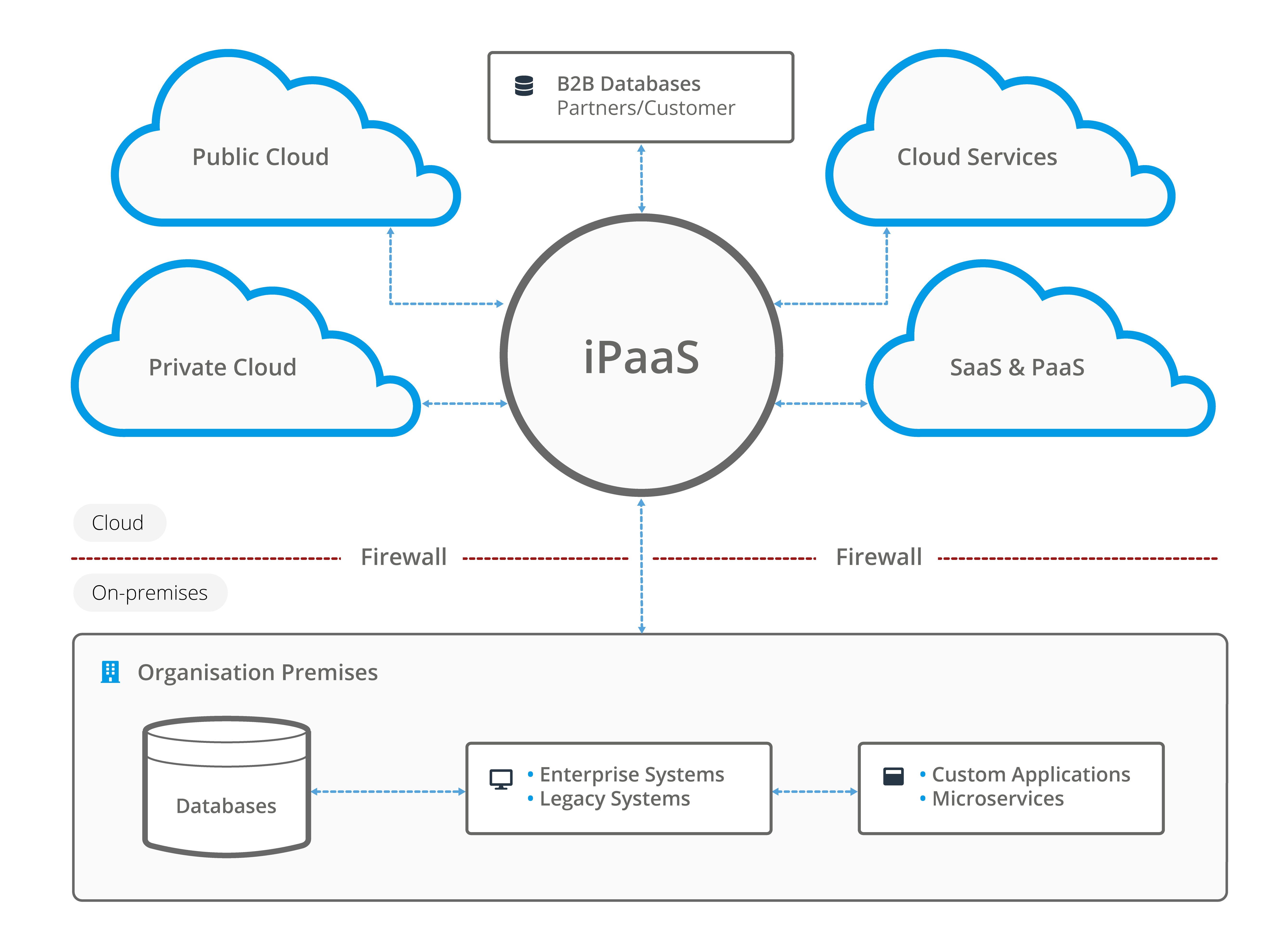
Image: A typical scenario using iPaaS to integrate on-premises with cloud-based applications and services
The strategic role of iPaaS
Deploying iPaaS as the foundation of a flexible integration platform enables businesses to break free from rigid architectures and create a connected ecosystem that evolves as quickly as they do.
It allows organisations to:
- Build a composable architecture where systems can be swapped in and out
- Accelerate digital transformation initiatives
- Respond quickly to market changes and customer expectations
In essence, iPaaS transforms integration from a bottleneck into a competitive advantage.
“The flexibility of BPA Platform is remarkable. The things that you can do with it are out of this world. It never ceases to amaze me. It’s an incredibly efficient and powerful tool. I always equate BPA Platform to being a staff member that never sleeps. It’s like an incredibly efficient person, or team of people, checking data, that never stops.”
Malcolm MacLean, Global Head of IT, Graff Diamonds
Investing in the future
As businesses continue to adopt new technologies and adapt to changing market demands, the ability to switch systems quickly and efficiently becomes a key differentiator.
Investing in a flexible integration approach enables organisations to reduce risk, increase agility, and build a technology ecosystem that evolves alongside their business.
If your current systems feel more like a constraint than an enabler, it may be time to rethink your integration strategy.
Are you looking to install a new CRM system, switch to a different eCommerce platform, or simply upgrading your existing systems? Discover how BPA Platform can help you simplify integration and provide you with the freedom to easily switch between systems. Contact us today or schedule a free demo.