Understanding iPaaS hosting approaches
Integration and business process automation is an essential component of any organisation’s technology stack these days, as businesses adopt cloud applications, SaaS tools, and new data-driven services at a rapid pace.
Integration Platform as a Service (iPaaS) has become the prime solution, enabling companies to connect these tools and services, and then automate workflows, and manage data with greater ease.
However, the one question that often becomes prominent in executive discussions is where should the iPaaS solution be hosted?
The choice of hosting model impacts not only the technical side of operations but also cost structures, compliance, scalability, and ultimately the speed at which the business can innovate.
Many organisations document iPaaS decisions as part of a digital transformation roadmap, so hosting, governance and integration delivery stay aligned as requirements change.
This article explores the major hosting options available for iPaaS, the business factors to consider, and guidance on how to select the right model for your organisation.
Vendor-hosted, partner-managed, and self-hosted explained
When choosing how to deploy an iPaaS solution, organisations generally face three distinct hosting models: Vendor-hosted, partner-managed, and self-hosted. Each model offers unique advantages, trade-offs, and operational implications depending on a company’s priorities for control, compliance, scalability, and cost.
Vendor-hosted
In the vendor-hosted model, the iPaaS provider delivers the complete platform, including both software and infrastructure, through the cloud. This is typically offered as a Software-as-a-Service (SaaS) solution, where the vendor manages every operational aspect: hosting, updates, maintenance, and scaling. Clients simply access and use the platform via a subscription or usage-based pricing model.
Because the vendor handles the underlying infrastructure, organisations can onboard quickly, avoid hardware investments, and focus on building integrations rather than managing systems.
Partner-managed
In a partner-managed setup, a third party, often a consulting firm, systems integrator, or managed service provider (MSP), takes on the responsibility of deploying, configuring, and possibly hosting the iPaaS on behalf of the client. This partner may operate using the vendor’s SaaS environment or deploy a licensed version of the product within their own infrastructure or the client’s. The partner also provides ongoing management, support, and optimisation, bridging the gap between the vendor’s technology and the client’s operational needs.
This approach is ideal for organisations that want more customisation or localised control without assuming the full operational burden of running their own infrastructure.
Self-hosted
With a self-hosted iPaaS, the client takes full ownership of the platform environment and architecture. The software, whether licensed or open source, is installed and operated within the organisation’s own infrastructure, in a private cloud. The client is entirely responsible for maintaining the system: managing hardware or virtual machines, ensuring network security, performing backups, applying updates, and scaling the environment as needed.
While this model demands significant technical expertise and operational capacity, it offers the highest level of control, data sovereignty, and customisation. It’s often the preferred choice for enterprises in highly regulated industries or those with complex, performance-sensitive integration needs.
Hybrid and mixed models
It rarely has to be purely one or the other. Many organisations use hybrid or mixed models: e.g. vendor-hosted for certain non-sensitive parts; self or partner-hosted for sensitive or high performance parts. Or start with vendor-hosted for speed, then migrate certain workloads inwards as requirements evolve.
Also, some vendors offer bring-your-own-infrastructure or private cloud / dedicated instance options, which straddle vendor-managed and self-hosted modes. That gives more control / compliance than fully shared cloud, but reduces operational burden somewhat, e.g. self-hosted with vendor support.
Decision criteria: What should you consider?
Which approach is “best” depends heavily on your situation. Here are factors to assess when choosing:
Total Cost of Ownership (TCO)
When evaluating iPaaS options, it is essential to consider the total cost of ownership (TCO), which goes far beyond software or licensing fees. Organisations must account for the costs of infrastructure, staffing, ongoing support, system monitoring, backups, and disaster recovery. Hidden expenses such as vendor lock-in, required migrations, connector deprecations, and compliance adjustments can also significantly impact budgets.
While self-hosted solutions may appear less expensive initially, the long-term costs of maintenance, upgrades, operational overhead, and missed business opportunities often exceed expectations. A careful TCO analysis ensures informed decisions and sustainable platform management.
Existing infrastructure and technical skillset
Organisations must realistically assess their internal technical capabilities before choosing a hosting model. Running an iPaaS platform involves more than installation; it requires ongoing expertise in system monitoring, security, network management, scaling, backups, and disaster recovery. Teams must also handle software upgrades, connector compatibility, and troubleshooting.
If internal resources are limited, a self-hosted model can become a significant operational burden. Vendor-hosted and partner-managed solutions mitigate these risks by shifting operational responsibilities to experienced providers, enabling organisations to focus on integration development while ensuring performance, reliability, and compliance.
Speed to market
Time-to-value is a critical factor for many organisations. Vendor-hosted iPaaS solutions provide the fastest deployment, as the platform is pre-configured, maintained, and hosted by the provider. Organisations can begin building integrations almost immediately.
Partner-managed solutions offer a middle ground, enabling rapid deployment while maintaining some level of customisation and control. Partners can handle operational complexity and accelerate setup, allowing organisations to iterate quickly on integrations without taking on full operational responsibility. Self-hosted models typically take longer to deploy due to infrastructure setup, configuration, and operational readiness.
Scalability and performance
Vendor-hosted solutions generally provide robust scalability, utilising cloud infrastructure and multi-tenant or multi-instance architectures. They often include SLAs for performance and uptime. Partner-managed solutions can achieve similar scalability, depending on the partner’s capabilities and infrastructure.
Self-hosted platforms require careful planning to ensure sufficient resources and high availability. Organisations opting for self-hosting must manage scaling, redundancy, and performance optimisation internally, which can be resource-intensive but provides fine-grained control over system behaviour.
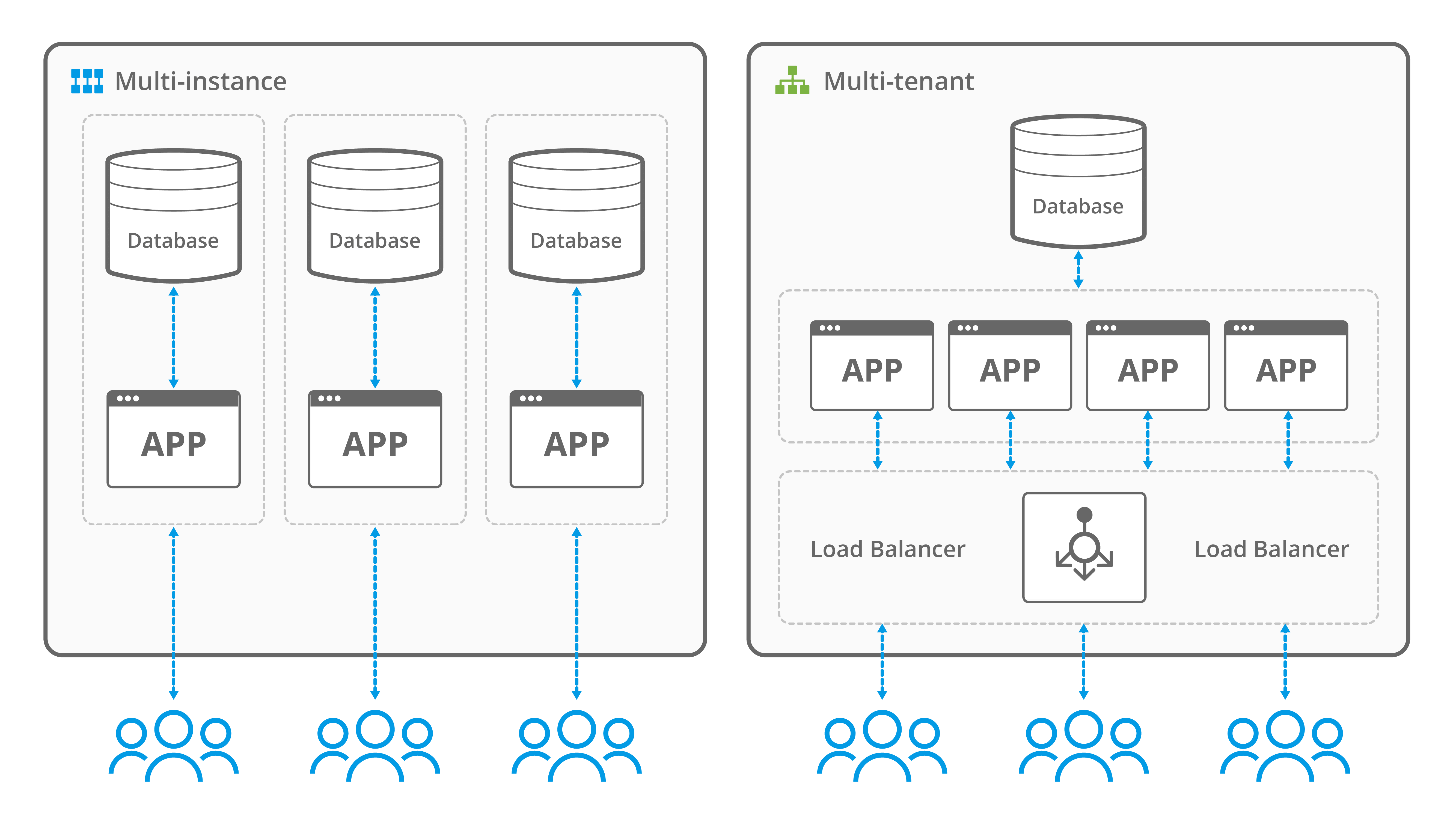
Image: Where data is stored determines the difference between multi-tenant and multi-instance architecture
Security, compliance, and data residency
Data security and regulatory compliance are central considerations in iPaaS hosting decisions. Vendor-hosted platforms often provide strong security measures and compliance certifications, but organisations may have limited control over data residency or auditability.
Partner-managed solutions can offer enhanced compliance by hosting the platform in specific jurisdictions or implementing custom security controls. Self-hosted deployments give organisations maximum control over data location, security configurations, and compliance enforcement, making them attractive for industries with strict regulatory requirements, such as healthcare, finance, or government sectors.
Comparison table
Use this table to quickly compare the different scenarios that you need to consider when selecting your ideal hosting option.
| Scenario | Vendor-hosted | Partner-managed | Self-hosted |
|---|---|---|---|
| Time to Deploy / Time to Value |
Fastest. Minimal setup – vendor handles infrastructure; you start using quickly.
|
Moderate. Some setup overhead, configuration, possibly customisation; partner adds time but also expertise.
|
Longest. Procuring, setting up infrastructure, installing, securing, customising takes time.
|
| Upfront Cost vs Ongoing Cost |
Lower upfront capital expenditure – costs are subscription/usage-based. Higher ongoing cost over time potentially depending on scale.
|
Upfront cost usually higher than pure vendor (partner fees, configuration). Ongoing costs include partner management fees plus vendor fees if SaaS.
|
High upfront: infrastructure, staffing, possible licensing. Ongoing costs include maintenance, hardware (or cloud) operations, staffing. Possibly lower licensing or vendor fees, but trade-offs apply.
|
| Operational Complexity / Burden |
Low for the customer: vendor handles upgrades, scaling, patches, uptime concerns, monitoring etc.
|
Medium: partner takes on some or much of the operational burden; but customer still needs to coordinate, manage partner, may have visibility concerns.
|
High: customer must manage everything operationally: infrastructure, patches, security, scaling, high availability etc. Requires skilled staff or teams.
|
| Control / Customisation |
Limited. You often get what the vendor offers (connectors, APIs, UI, data flows). Custom work may be constrained by vendor’s roadmap or what’s allowed.
|
Better. Partner often can tailor or customise more, sometimes even build custom connectors or workflows. But still subject to vendor’s underlying constraints.
|
Maximum. Full control over environment, software versioning, custom connectors, how infrastructure is organised, security / compliance, performance tuning etc.
|
| Security / Compliance |
Vendor may provide strong security, certifications, but you often have less ability to directly audit or modify. Data may reside in vendor-controlled data centres.
|
Partner may help satisfy compliance requirements / tailor hosting / setup to meet data sovereignty etc. If partner hosts in acceptable region or in private cloud, some more control.
|
Highest potential: you control where data lives, how the platform is configured, network security, auditing etc. Appeals to highly regulated industries.
|
| Scalability / Reliability |
Vendor-hosted solutions often scale well (cloud infrastructure, multi-tenant, auto-scaling etc.). Vendor usually provides SLAs. Reliability is part of the service.
|
Potentially similar to vendor if partner has strong operations, or uses vendor SaaS. But reliability depends on partner’s capability; risk of weaker SLA or management processes.
|
Scalability depends entirely on your capacity and skill. Building highly available, resilient, auto scaling infrastructure can be quite costly and complex. Risks in failure, capacity planning etc.
|
| Cost Predictability |
Often predictable subscription or usage-based – although usage spikes may increase costs. Vendor handles many variable costs internally.
|
Somewhat predictable, though partner fees may have variability; might include custom work/changes which cost more.
|
Can be unpredictable: unexpected maintenance, scaling costs, staffing, licensing, infrastructure overages; you absorb variance.
|
| Support and Expertise |
Vendor provides support, often 24/7, expert teams, updates, maturity etc.
|
Partner brings consulting / implementation / customisation expertise; may offer ongoing support (with SLAs) possibly closer/more responsive locally.
|
You need internal expertise for everything; may hire consultants, but your team is on the hook. If problems arise, you have to resolve or escalate yourself.
|
Self-hosted iPaaS: capital expenditure and tax relief considerations
For organisations evaluating self-hosted iPaaS solutions, one of the biggest distinctions from cloud-hosted models is the financial treatment of the investment.
Unlike public cloud subscriptions that are typically accounted for as operational expenses (OpEx), self-hosting requires significant capital expenditure (CapEx).
This CapEx covers costs such as:
- Hardware: Servers, storage systems, and networking equipment.
- Software licenses: iPaaS platform licenses and related middleware.
- Infrastructure: Data centre facilities, power, cooling, and security.
- Staffing and maintenance: Internal IT personnel for monitoring, updates, and support.
CapEx vs. OpEx impact
- CapEx: Large upfront investment that appears on the balance sheet and is depreciated over time (often 3–7 years for IT assets, depending on jurisdiction). This can strain cash flow in the short term but may be attractive to businesses seeking to build equity in their own infrastructure.
- OpEx: With cloud-hosted iPaaS, costs are spread across predictable monthly or annual subscriptions, which are immediately deductible as business expenses. This improves cash flow and often reduces administrative overhead.
Tax relief opportunities
Many governments offer tax incentives to encourage businesses to invest in their own IT infrastructure. These may include:
Capital allowances / depreciation deductions
- In many regions, businesses can write off the cost of servers, storage, and other IT equipment against taxable income over the asset’s useful life.
- Some governments allow accelerated depreciation, enabling businesses to claim a larger deduction in the first year.
R&D tax credits
- If the iPaaS deployment is part of an innovative integration project, certain costs associated with implementation may qualify for R&D tax relief.
Investment incentives
- Certain countries provide bonus deductions or tax credits for digital transformation initiatives, data centre modernisation, or IT security investments.
Offsetting leasing costs
- If infrastructure is leased rather than purchased outright, payments may be treated as operating expenses, offering more flexibility in tax treatment.
Business implications
While self-hosting iPaaS may appear more expensive upfront, the ability to capitalise infrastructure investments can improve the company’s balance sheet and, with the right tax planning, reduce overall tax liability.
However, business owners should also factor in the opportunity cost: tying up capital in servers and data centres may reduce the ability to invest in growth initiatives, whereas cloud-based OpEx models preserve flexibility and liquidity.
In practice, the best choice often depends on the company’s financial strategy:
- Businesses aiming to maximise short-term cash flow and keep balance sheets lean often prefer cloud subscriptions.
- Those seeking to capitalise assets and benefit from tax relief may find self-hosting advantageous — particularly if they already operate large-scale IT environments or are in industries with strict data sovereignty rules.
Which hosting option? Some typical business scenarios
Different organisations have different integration priorities: speed, control, cost-efficiency, compliance, or scalability. These priorities determine which iPaaS hosting model is most suitable. The right approach depends on the organisation’s size, technical maturity, regulatory environment, and operational goals. Below are several common scenarios illustrating when each hosting model makes the most sense.
For small to medium businesses needing fast results
Smaller organisations with limited integration requirements and minimal regulatory constraints often benefit most from a vendor-hosted iPaaS. This approach offers rapid deployment, minimal maintenance, and predictable costs.
Businesses can begin automating workflows and connecting applications almost immediately without worrying about infrastructure or security management. It’s ideal for companies that value agility and ease of use over customisation or tight control.
For large enterprises with complex, hybrid environments
Enterprises that operate across multiple data centres, combine legacy on-premises systems with modern cloud applications, and require numerous custom connectors face unique integration challenges. These organisations often benefit from a partner-managed or self-hosted solution, sometimes in a hybrid configuration.
A partner-managed model can simplify deployment and provide scalable operational support, while self-hosting critical components ensures control and compliance for sensitive workloads. Hybrid setups are particularly effective here, using vendor-hosted iPaaS for less critical integrations and self- or partner-hosted models for mission-critical systems.
For cost-conscious organisations with high reliability needs
Companies that have limited budgets for internal operations but still require high reliability and compliance often find success with a vendor-hosted iPaaS backed by strong service-level agreements (SLAs).
This model minimises staffing and infrastructure expenses while ensuring enterprise-grade uptime and support. However, if the vendor’s compliance capabilities do not fully meet regional or industry-specific requirements, a partner-managed alternative can offer a similar hands-off experience with more localised hosting and control.
For regulated industries requiring strict compliance
Organisations operating in heavily regulated sectors, such as healthcare, finance, or government, must maintain strict control over data privacy, residency, and compliance standards. In these cases, a partner-managed or self-hosted iPaaS often makes the most sense.
Partner-managed solutions allow organisations with limited in-house resources to achieve compliance through expert guidance and localised hosting, while self-hosting gives full control to internal teams that have the technical capacity to manage infrastructure and security directly. The choice between the two depends largely on available resources and the desired level of autonomy.
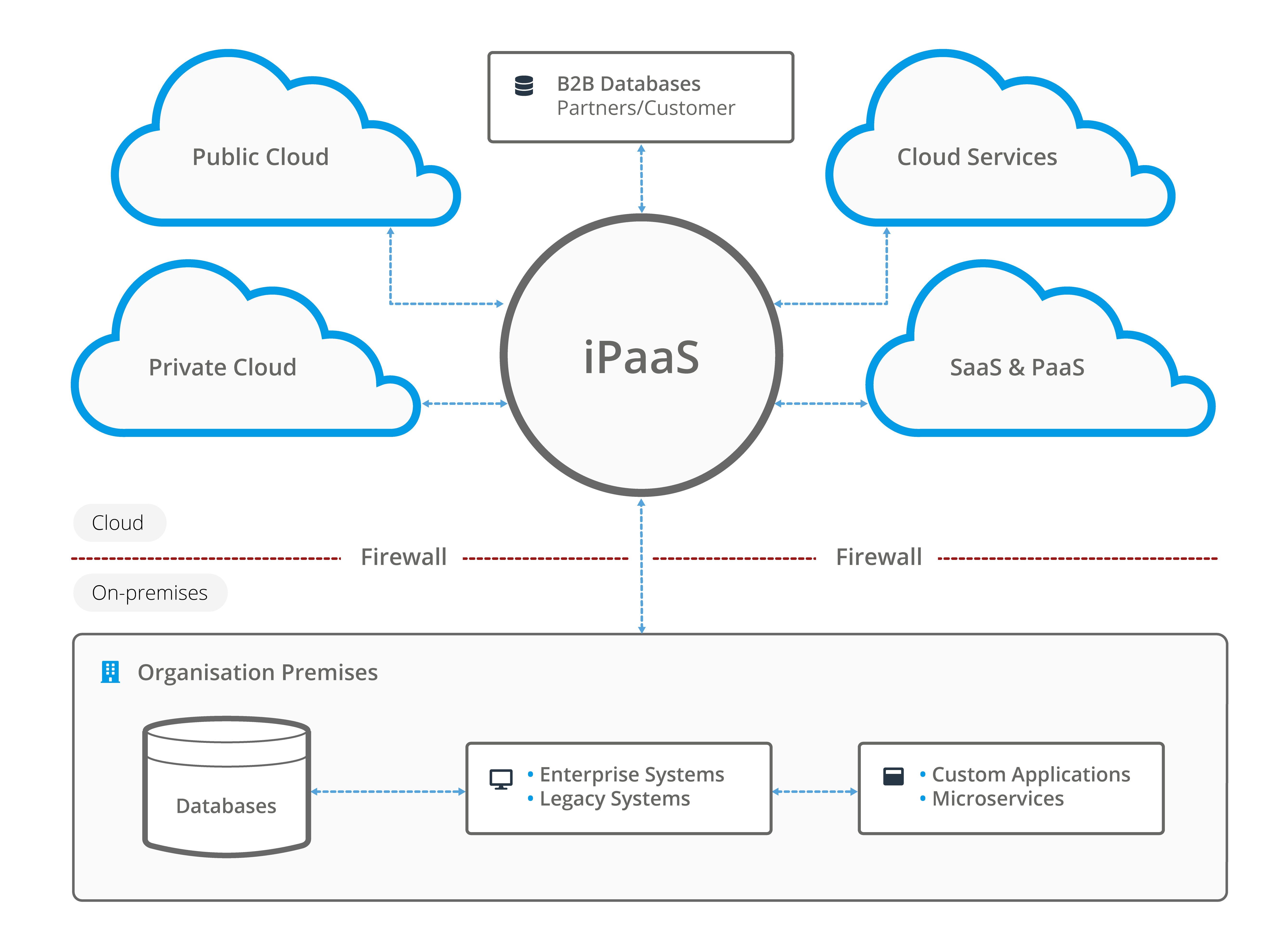
Image: A typical scenario using iPaaS to integrate on-premises with cloud-based applications and services
Pros and cons of hosted options
Here are some direct lists of advantages and drawbacks.
Vendor-hosted
Pros:
- Quick deployment, minimal setup.
- Vendor handles operational burden: infrastructure, updates, maintenance.
- Often better SLAs (uptime, support).
- Easier scaling – vendor probably has redundancy, global distribution etc.
- Lower risk of misconfiguration / security slips due to infrastructure because vendor likely has best practices baked in.
Cons:
- Less control over certain things (data location, custom connector support, specific latency optimisations, versioning).
- Ongoing subscription costs; may become expensive for large scale / high usage.
- Possible vendor lock-in in connectors, features, API versioning.
- Less flexibility for unique or niche integration requirements.
- When vendor decides roadmap / deprecations, you must adapt.
Partner-managed
Pros:
- Access to expertise; partner can customise, integrate, configure per your needs.
- Can relieve in-house burden without giving up control entirely.
- If partner hosts in acceptable jurisdiction, may help meet data residency / compliance needs.
- Decent trade-off between fully managed and fully self-supplied.
Cons:
- Additional cost of partner involvement (setup, ongoing maintenance).
- Dependency on partner for reliability: their staffing, expertise, SLAs.
- Possible delays for custom work; potentially less visibility into internal operations.
- Risk if partner is weak or cannot scale / adapt.
Self-hosted
Pros:
- Maximum control: over infrastructure, environment, data, customisation, security.
- Potentially lowest vendor fees / licensing; especially if using open source or BYOI models.
- Data residency / compliance is easier to enforce, since you control what is installed where.
- Custom connectors, modification etc are fully possible.
Cons:
- Significant effort and cost initially: infrastructure, staff, operations.
- Risk of underestimating operational burdens (monitoring, scaling, upgrading).
- Security, backups, disaster recovery are your responsibility.
- More complexity in ensuring high availability, reliability, redundancy.
- Slower time to value – possibly more risk during deployment.
While selecting an iPaaS hosting model, whether vendor-hosted, partner-managed, or self-hosted, organisations must be aware that every approach carries potential risks and hidden costs. These pitfalls are often underestimated during initial planning but can have a significant impact on operations, budgets, and long-term strategy.
One of the most immediate concerns is the maintenance burden, particularly for self-hosted deployments. Organisations that manage their own infrastructure are responsible for software upgrades, security patches, monitoring, backups, and disaster recovery. They must also handle connector version updates and ensure compatibility across multiple systems. Neglecting any of these tasks can lead to downtime, security vulnerabilities, or integration failures.
Changes by the vendor or partner represent another source of risk. Vendors may alter their product roadmap, deprecate connectors, modify pricing structures, or enforce migrations to new platforms. Even partner-managed solutions are subject to similar uncertainties, especially if the partner relies on the vendor’s technology stack. Such changes can create unexpected costs, disrupt integration workflows, or introduce dependency risks.
Performance issues are also common hidden costs. Vendor-hosted platforms may impose limits on shared infrastructure, potentially affecting latency, throughput, or system reliability. Conversely, self-hosted environments may struggle with insufficient resources if infrastructure is not properly planned or scaled. These performance surprises can compromise business-critical integrations and require additional investment in hardware or cloud resources.
Compliance and security oversight is another area that can catch organisations off guard. Even when leveraging vendor or partner solutions, companies cannot assume full compliance by default. Certifications, audit logs, and data flow management must be actively verified to meet internal policies or regulatory requirements. Self-hosted environments further increase the responsibility, as organisations must implement and maintain security controls entirely on their own.
Finally, support and reliability considerations can create hidden risks. While vendors and partners often provide Service Level Agreements (SLAs), these documents may contain limitations or conditions that are not immediately apparent. Organisations relying on self-hosted solutions bear full accountability for system uptime and issue resolution, which can expose them to operational weaknesses without an external safety net.
In short, every hosting model for iPaaS has trade-offs beyond the obvious costs of licensing or subscription fees. Understanding and planning for these hidden challenges (maintenance, vendor changes, performance variability, compliance requirements, and support limitations) is critical for making a sustainable, strategic choice.
Choosing the right model
Ultimately, the choice of hosting model for iPaaS should not be treated as an IT decision alone. It must align with corporate strategy.
Businesses should begin by asking: Do we prioritise cost savings, compliance, speed, or resilience? The answer to that question often points directly to the most suitable hosting model.
Engaging both finance and IT leaders early in the process ensures that trade-offs between CapEx and OpEx, compliance risks, and long-term scalability are fully understood.
Most importantly, businesses should take a long-term view. Hosting decisions made today should support not only current integration needs but also the growth and evolution of the business in the years ahead.
- Vendor-hosted solutions are ideal for organisations seeking rapid deployment, minimal operational burden, and predictable performance.
- Partner-managed approaches suit businesses that need a tailored, guided implementation with moderate operational oversight.
- Self-hosted deployments are best for organisations with strong technical expertise, regulatory demands, or specific performance and control requirements.
- Hybrid models — combining vendor-hosted and self-hosted elements—can also provide a flexible strategy, addressing different integration workloads according to sensitivity, scale, and compliance needs.
Selecting the right hosting option for iPaaS is far more than a technical decision. It is a strategic business choice that influences ROI, compliance, agility, and competitiveness.
Carefully considering business goals, risk appetite, and long-term scalability, enables businesses to make informed decisions that position it for both operational efficiency and sustained growth.
For more information on how iPaaS can help your business, download the brochure below or call us on +44(0) 330 99 88 700.